Plays from youtube-nocookie.com once you press play.
Alexander Graham Bell He Changed How the World Communicates
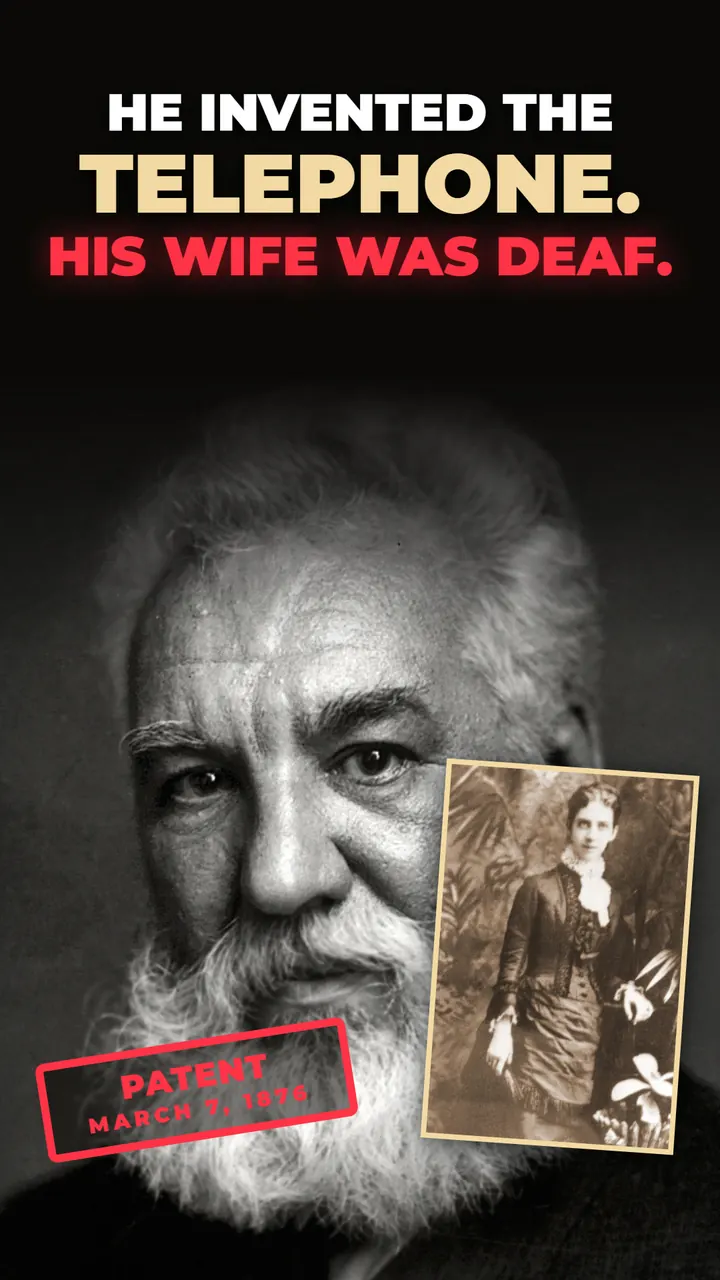
He invented the telephone. But his mother could barely hear, and the woman he married could not hear at all.
Alexander Graham Bell grew up in Edinburgh, the son of a speech teacher and an almost-deaf mother. After both of his brothers died of tuberculosis, his family moved to Canada. In Boston he taught deaf children and fell in love with one of his students, Mabel Hubbard. On February 14, 1876, his telephone patent was filed on the same day as Elisha Gray's papers for a similar idea, only hours apart. On March 10 he spoke the first words: "Mr. Watson, come here. I want to see you."
He went on to build a metal detector for President Garfield, send sound on a beam of light, fly giant kites and set a speed record on water. When he died in 1922, telephone service across North America went silent for one minute.
The facts behind this file
What the record shows
- Bell was born in Edinburgh on 3 March 1847. His mother gradually lost her hearing.
- Both his brothers died of tuberculosis, and the family moved to Canada in 1870.
- He opened a school in Boston in 1872 and on 11 July 1877 married Mabel Hubbard, who was deaf.
- On 10 March 1876 he spoke the first words over the telephone: 'Mr. Watson—Come here—I want to see you.'
- He sent sound over a beam of light with the photophone (1880), built giant kites, and on 9 September 1919 his hydrofoil HD-4 reached 70.86 mph, a world record. He died on 2 August 1922.
Legends, disputes & careful wording
- Bell's patent and Elisha Gray's caveat both reached the patent office on 14 February 1876. Which came first is still disputed.
- His metal detector failed to find the bullet in President Garfield in 1881; some accounts blame the metal bed springs.
- That telephones across North America fell silent during his funeral is often repeated; we could not confirm it.
Main sources
- Charlotte Gray, Reluctant Genius (2006)
- Robert V. Bruce, Bell: Alexander Graham Bell and the Conquest of Solitude (1990)
Spotted a mistake or know a better source? Tell us.
Further reading
As an Amazon Associate, Inventor Files earns from qualifying purchases. It costs you nothing extra.
Image & film credits
- Bell Homestead, Brantford: Harry Zilber, CC BY-SA 3.0 · Anne Sullivan and Helen Keller (colorized): Michael T Sanders, CC BY-SA 4.0.
- Other archival photos are public domain or CC0 (Library of Congress, National Archives, Smithsonian NPG); video clips from Pexels.
- Music and sound made for this video.