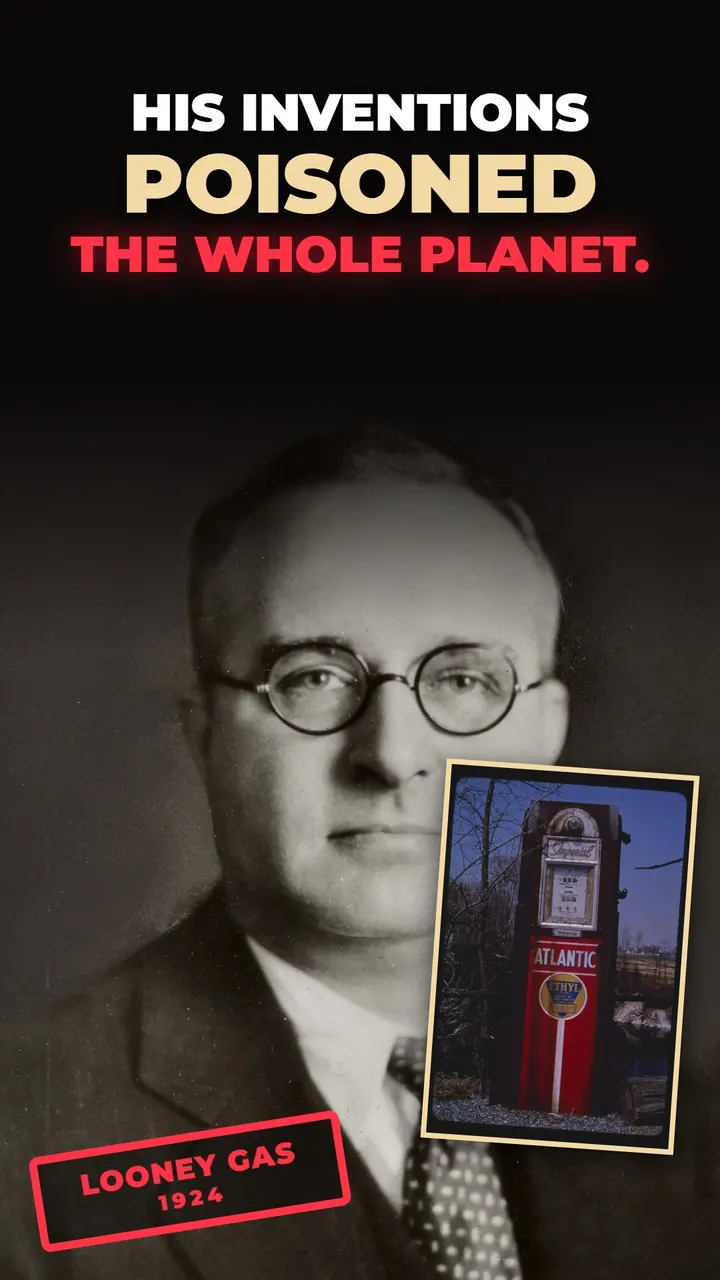
Episode thumbnail: Thomas Midgley Jr.

Plays from youtube-nocookie.com once you press play.

Short · 2:35 · 2-min read

Thomas Midgley Jr. His Inventions Poisoned the Whole Planet

One man changed the air of the entire planet. Twice.

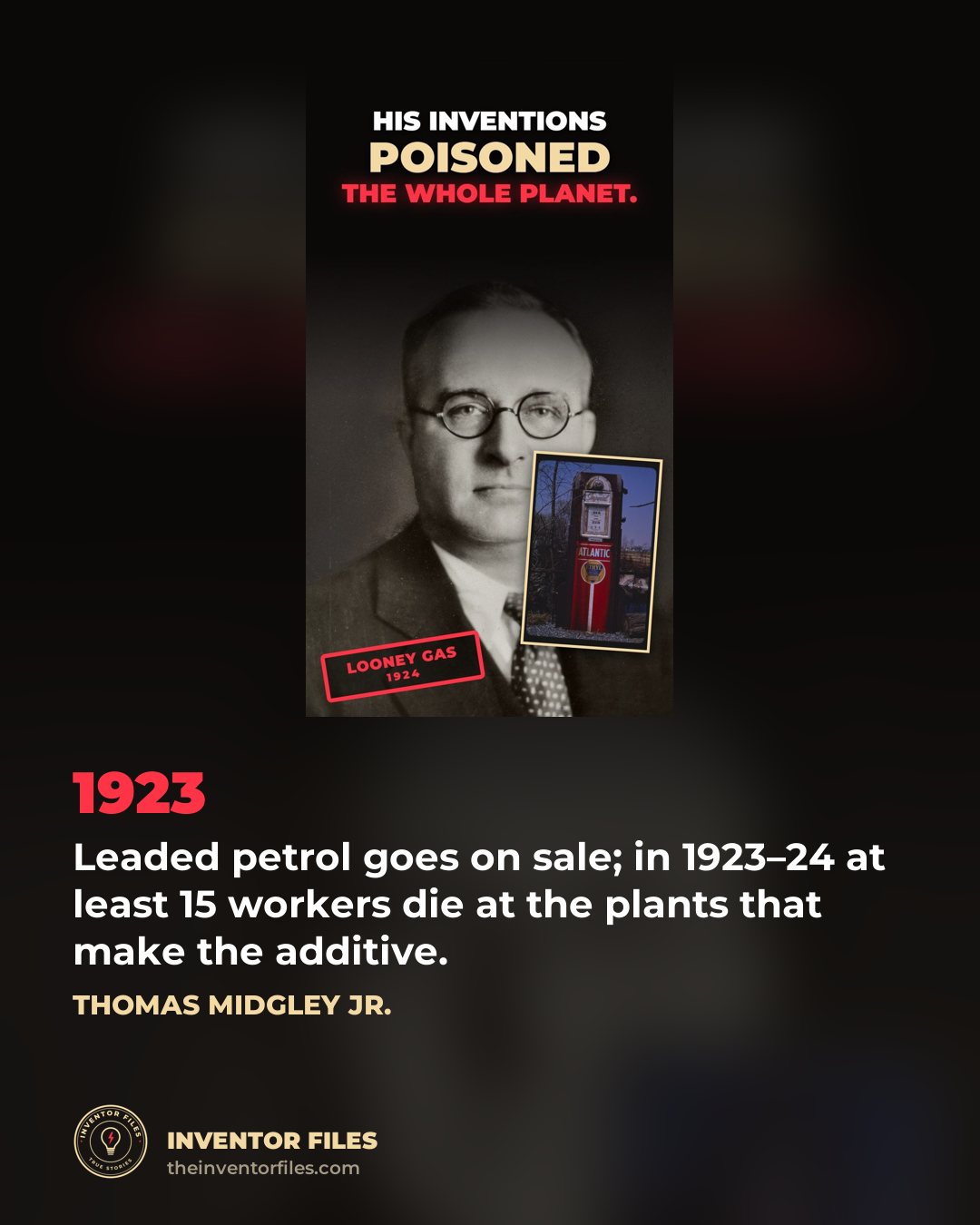
Thomas Midgley Jr. was a brilliant, cheerful engineer. In 1921 he found a cure for knocking car engines: tetraethyl lead. The company sold it as "Ethyl" and left the word lead out. In 1924 factory workers began to hallucinate and at least fifteen died; newspapers called it "looney gas". Midgley answered with a press conference, pouring the liquid over his hands and breathing its fumes, months after he himself had been treated for lead poisoning.

Then he gave the world Freon, a refrigerator gas that seemed perfectly safe. It went into fridges, air conditioners and spray cans, and decades later it was found to be tearing a hole in the ozone layer. In 1940 polio paralysed his legs, and he built himself a system of ropes and pulleys to get out of bed. In 1944 he was found tangled in those ropes. Whether it was an accident is still debated.

Read the full story 2 min ↓

The facts behind this file

What the record shows

  • At least 15 workers died at the tetraethyl lead plants in Dayton, Deepwater (DuPont) and Bayway (Standard Oil) in 1923–1924.

Legends, disputes & careful wording

  • His death in 1944 is often told as 'killed by his own invention'. The official record and historians disagree on whether it was an accident or suicide.
  • The line that he had 'more impact on the atmosphere than any other single organism in Earth's history' is the judgement of one historian, J. R. McNeill, not a measured fact.

Main sources

  • J. R. McNeill, Something New Under the Sun (2000)

Spotted a mistake or know a better source? Tell us. How we check the facts.

Image & film credits
  • Portraits of Thomas Midgley Jr.: Blank & Stoller, N.Y., via Wikimedia Commons (no known restrictions).
  • All other archival images are public domain or CC0 (Library of Congress, NASA, USDA, John Margolies Roadside America collection); video clips from Pexels.
  • Music and sound made for this video.

In this story
  1. A cheerful problem-solver
  2. The knock
  3. Looney gas
  4. Freon
  5. The ropes
  6. What he never saw

The full story · 2 min read

Thomas Midgley Jr.: the man who changed the air of the planet, twice

Thomas Midgley Jr. gave the world leaded petrol and the refrigerator gas Freon. Both seemed like brilliant solutions, and both turned out to be disasters. The full story of the engineer, and the strange way he died.

A cheerful problem-solver

Thomas Midgley Jr. was born in Beaver Falls, Pennsylvania, in 1889. By all accounts he was a brilliant and cheerful engineer who loved a hard problem. In 1916 he joined the inventor Charles Kettering in Dayton, Ohio.

The knock

Car engines of the time had a serious problem: knocking, a violent rattle that wasted fuel and damaged engines. Midgley spent years testing compound after compound to add to petrol. In December 1921 he found one that worked: tetraethyl lead.

Engines ran smoothly and powerfully. There was just one problem: lead is a poison. The product was marketed as "Ethyl", without the word lead.

Looney gas

In 1923 and 1924 workers at the plants that made tetraethyl lead, in Dayton, at DuPont's works in Deepwater, New Jersey, and at Standard Oil's plant in Bayway, began to suffer hallucinations and violent fits. At least fifteen of them died. Newspapers called the stuff "looney gas".

Midgley responded with a press conference in October 1924. He poured tetraethyl lead over his hands and breathed its fumes for about a minute, and told reporters he could do so every day without harm. He did not mention that not long before, he himself had needed treatment for lead poisoning.

Leaded petrol went around the world. For decades, hundreds of millions of cars blew lead into the air.

Freon

Midgley then turned to refrigerators, which at the time used toxic or flammable gases that could leak and kill people. In 1928 his team created a new gas that seemed perfectly safe: a chlorofluorocarbon, sold as Freon. To show how harmless it was, he inhaled it at a demonstration and blew out a candle.

CFCs were soon everywhere: in refrigerators, air conditioners and spray cans. Midgley received the highest honours in American chemistry.

The ropes

In 1940, at 51, Midgley caught polio and was left with paralysed legs. True to form, he designed a system of ropes and pulleys to help himself out of bed. In November 1944 he was found entangled in those ropes and died, at 55. His death is often told as "killed by his own invention", but the official record and historians disagree on whether it was an accident or suicide.

What he never saw

Decades after his death, scientists found that people carried far more lead in their bodies than their ancestors had, with harm to children's health and development. And in the 1970s and 1980s scientists showed that CFCs were destroying the ozone layer, which protects life from ultraviolet radiation.

Country after country banned both. The 1987 Montreal Protocol phased out CFCs, and the last leaded petrol for cars was sold in 2021.

The historian J. R. McNeill wrote that Midgley "had more impact on the atmosphere than any other single organism in Earth's history". That is one historian's judgement, not a measurement, but it is hard to argue with. Midgley solved every problem in front of him. He never asked what would happen next.

Sources

  • J. R. McNeill, Something New Under the Sun (2000)
  • Wikipedia: Thomas Midgley Jr.; Tetraethyllead; Chlorofluorocarbon

Researched and written by Inventor Files, last checked 2026-10-31. Found a mistake? Tell us.