Plays from youtube-nocookie.com once you press play.
Elisha Otis He Ordered Them to Cut His Elevator’s Rope. With Him Onboard.
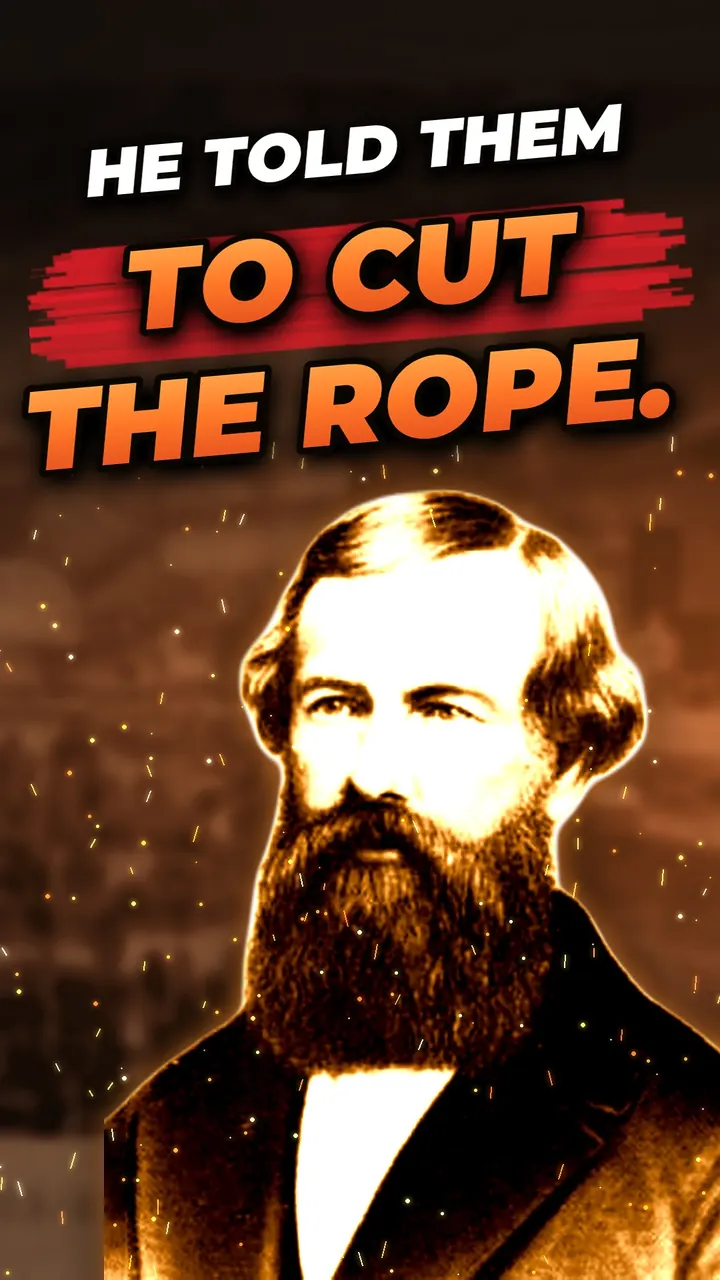
In 1854, a man stood on a platform high above a crowd in New York and ordered his assistant to cut the only rope holding him up. The crowd gasped. The platform did not fall.
Elisha Otis was born on a Vermont farm in 1811. He drove wagons, ran a sawmill and built carriages; most of his businesses failed, and his first wife died young. In his forties, working in a bedstead factory in Yonkers, he did not trust the rope on the factory hoist. So he built a safety brake: a wagon spring at the top and teeth along the rails, so that a snapped rope locked the platform in place.
He was about to leave for the California gold fields when furniture makers asked for his safe hoist. He stayed. At the Crystal Palace in New York he showed the crowd, with an axe. In 1857 the first passenger elevator with his brake went into a store on Broadway, and cities could finally grow upward. He died in 1861, at 49. His sons carried on, and their elevators went into the Eiffel Tower and the Empire State Building.
The facts behind this file
What the record shows
- Born 3 August 1811 in Halifax, Vermont; died 8 April 1861 of diphtheria, aged 49.
- He built his safety brake around 1852 at a bedstead factory in Yonkers.
- He demonstrated it at the Exhibition of the Industry of All Nations in New York in 1854.
- The first passenger elevator opened in the E. V. Haughwout store, 488 Broadway, on 23 March 1857.
- Otis built the original lifts in the Eiffel Tower's north and south legs (1889).
Legends, disputes & careful wording
- His famous words 'All safe, gentlemen, all safe' come from the traditional account of the demonstration.
- 'About two billion people a day' is the Otis company's own figure.
Spotted a mistake or know a better source? Tell us.
Further reading
As an Amazon Associate, Inventor Files earns from qualifying purchases. It costs you nothing extra.
Image & film credits
- all images are public domain or CC0 (Wikimedia Commons: Otis portrait and 1854 demonstration illustration, 1861 patent drawing (NARA), New York Crystal Palace by Karl Gildemeister and Charles Parsons, Eiffel Tower 1888 by Louis-Emile Durandelle, Lewis Hine, Samuel H. Gottscho). Video clips from Pexels. Music and sound made for this video.
- This video is not affiliated with Otis Elevator Company.