Plays from youtube-nocookie.com once you press play.
Clarence Dally He Tested X-Rays for Edison. Then Lost Both Arms.
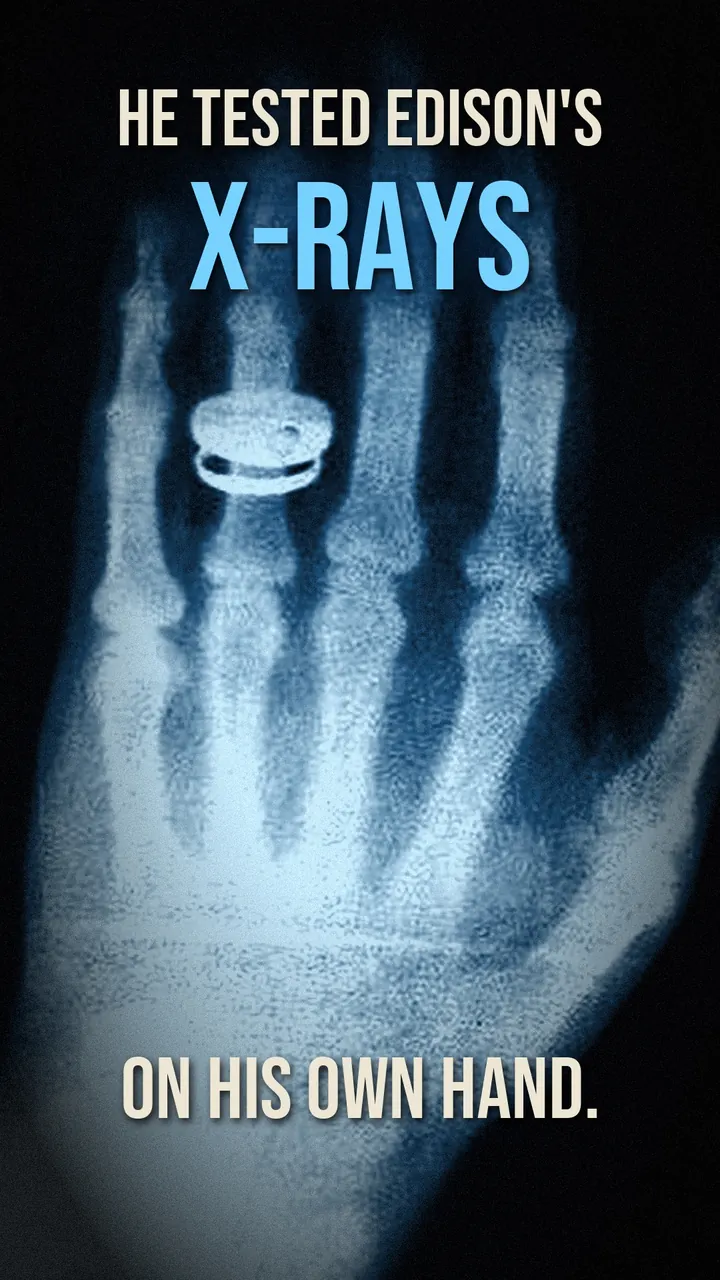
In 1895 Wilhelm Röntgen discovered X-rays, and within weeks the whole world wanted them. Thomas Edison gave the job of building better X-ray tubes to Clarence Dally, a glassblower from his lamp works who had joined the Navy at sixteen. To check whether a tube worked, Dally, who was right-handed, held up his left hand in front of it and looked at the screen. Nobody yet knew what the rays could do. By 1900 his hands and face were badly damaged. Skin grafts failed; in 1902 his left hand was amputated, then four fingers of his right, and later both arms. He died on 2 October 1904, aged 39, leaving a wife and two sons. He is thought to be the first American to die from experimenting with X-rays. Edison stopped working with them: "Don't talk to me about X-rays, I am afraid of them."
The facts behind this file
What the record shows
- Born in 1865, he joined the Navy at sixteen and became a glassblower at the Edison Lamp Works and the West Orange laboratory.
- He was right-handed, so he tested X-ray tubes by holding up his left hand.
- By 1900 the damage to his hands and face kept him from work. Skin grafts failed; in 1902 his left hand was amputated, then four fingers of the right, and later both arms.
- He died on 2 October 1904, aged 39, leaving his wife Maud and two sons. He is thought to be the first American to die from radiation experiments.
Legends, disputes & careful wording
- How many hours a day he tested tubes is not documented.
- Edison's 'Don't talk to me about X-rays, I am afraid of them' comes from the New York World of 3 August 1903.
Main sources
- The New York Times, 4 October 1904
- Smithsonian Magazine
- Wikipedia: Clarence Madison Dally
Spotted a mistake or know a better source? Tell us.
Image & film credits
- Film (public domain, via Wikimedia Commons): Dr John Macintyre's X-ray films, Glasgow, 1896–1897; "A Day with Thomas A. Edison" (1922); an early glassblowing film fragment (EYE Filmmuseum, "Bits & Pieces" BP187).
- Photos (public domain or no known restrictions, via Wikimedia Commons): Röntgen's X-rays of his wife's hand (1895) and of Albert von Kölliker's hand (1896), Wilhelm Röntgen (1900), an 1896 X-ray of fingers (Walter König), an X-ray demonstration and the "hemisphere of X-ray activity" diagram (William J. Morton, 1896), Thomas Edison (American X-ray Journal, 1899), Edison looking through a fluoroscope (1896), Edison at his West Orange laboratory (1904), Edison's West Orange staff (1893), the American X-ray Journal (1897).
- X-ray tube, England, 1896–1900: Wellcome Collection, CC BY 4.0. Crookes tube in use: D-Kuru, CC BY-SA 3.0 AT.
- Video clips from Pexels. Narration and music made for this video.