Episode thumbnail: Ada Lovelace

Plays from youtube-nocookie.com once you press play.

Short · 2:38 · 2-min read

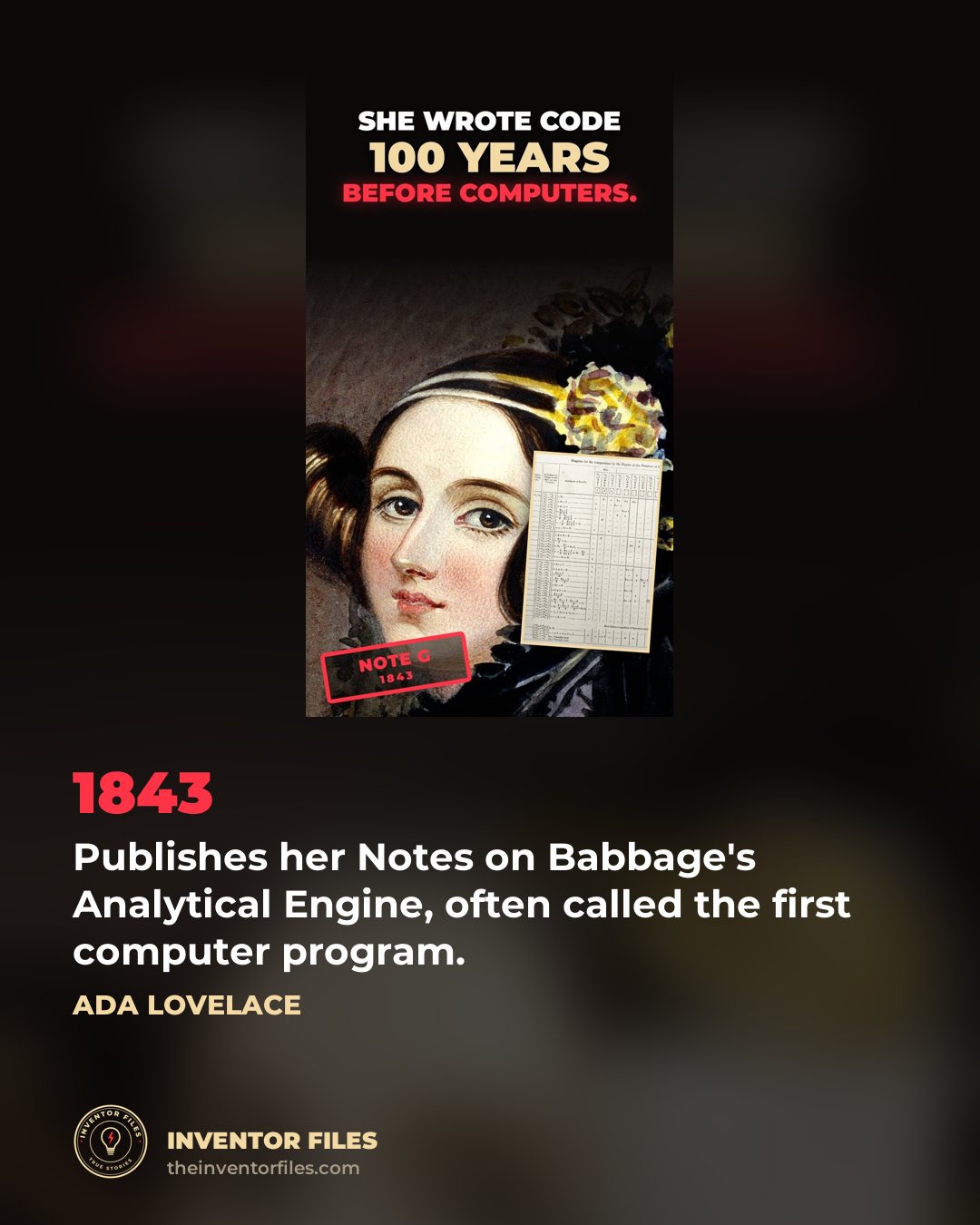
Ada Lovelace She Wrote Code 100 Years Before Computers

She wrote a computer program a hundred years before the first computer existed.

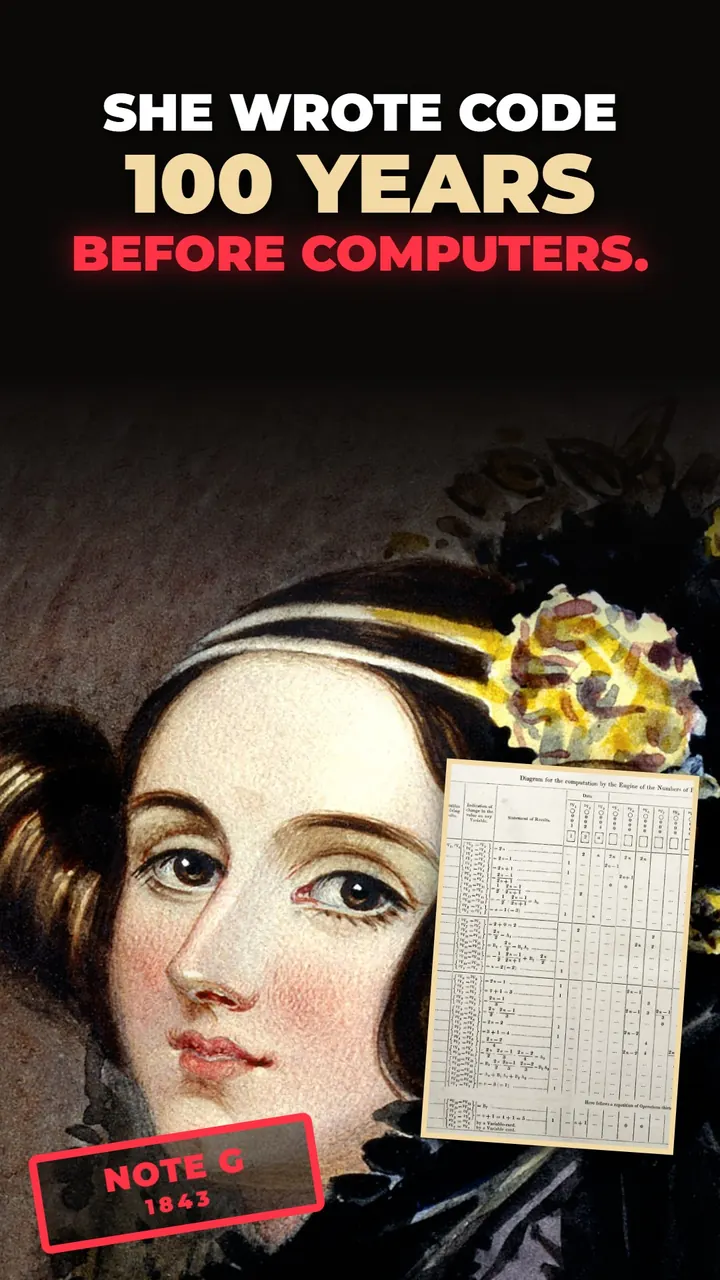
Ada Lovelace was the daughter of Lord Byron, the most famous poet in the world. Her mother was determined that she would never become like him, so she raised Ada on mathematics. At 17, Ada met the inventor Charles Babbage and understood his machines when most people only stared. In 1843 she translated an article about his Analytical Engine and added her own notes, three times longer than the article itself. In the last one, Note G, she wrote out step by step how the engine could calculate the Bernoulli numbers: what many call the first computer program ever published.

She also saw further than Babbage himself: a machine that might one day compose music. The engine was never built. Ada died in 1852, at 36, the same age as her father, and was buried next to him. A century later Alan Turing wrote about her, and today a programming language carries her name.

Read the full story 2 min ↓

The facts behind this file

Legends, disputes & careful wording

  • Her notes on Babbage's Analytical Engine are often called the first computer program. Historians still debate how much of the work was hers and how much was Babbage's, and the episode says so.

Main sources

  • Ada Lovelace's 'Notes' on the Analytical Engine (1843)

Spotted a mistake or know a better source? Tell us. How we check the facts.

Further reading

As an Amazon Associate, Inventor Files earns from qualifying purchases. It costs you nothing extra.

Image & film credits
  • Difference Engine fragment: Eric and Mary Ellen (mellen_petrich), CC BY-SA 2.0 · Punched cards for the Analytical Engine: Karoly Lorentey, CC BY 2.0 · Jacquard loom, National Museum of Scotland: Stephencdickson, CC BY-SA 4.0 · St Mary Magdalene, Hucknall: Phil Evans, CC BY-SA 2.0.
  • Other archival images are public domain or CC0 (Analytical Engine trial model: Daderot, CC0); video clips from Pexels.
  • Music and sound made for this video.

In this story
  1. The poet's daughter
  2. The Difference Engine
  3. A machine that could be programmed
  4. The Notes
  5. A life cut short
  6. Rediscovered

The full story · 2 min read

Ada Lovelace: the poet's daughter who saw what a computer could be

Ada Lovelace was Lord Byron's daughter, raised on mathematics to keep her from becoming like him. In 1843 she wrote notes on a machine that was never built, which many call the first computer program. The full story.

The poet's daughter

Augusta Ada Byron was born in London in 1815. Her father was Lord Byron, the most famous poet of his day. When she was a month old her parents separated, and she never saw her father again. He died in Greece when she was eight.

Her mother, Lady Byron, feared that Ada had inherited her father's wild imagination. Her cure was mathematics, studied with tutors every day. But imagination found a way in. At twelve Ada studied birds and tried to design a flying machine; she called the project "Flyology". As a teenager a serious illness left her unable to walk for a long time, and she kept studying from her bed.

The Difference Engine

At seventeen, at a party in London, she met the inventor Charles Babbage. He showed his guests part of his Difference Engine, a machine of brass gears that could calculate tables of numbers by itself. Most people just stared. Ada understood how it worked. They stayed friends for the rest of her life.

A machine that could be programmed

Babbage had an even bigger plan: the Analytical Engine. It would be programmed with punched cards, like the Jacquard looms used to weave patterns into cloth. It had a "store" for numbers, a memory, and a "mill" that did the calculations, a processor. In everything but name, it was a general-purpose computer.

The Notes

In 1843 Ada translated an article about the Analytical Engine by the Italian engineer Luigi Menabrea from French into English, and added her own notes. The notes ended up about three times as long as the article.

In the last of them, Note G, she set out step by step how the engine could calculate a sequence of numbers known as the Bernoulli numbers. Many people call it the first computer program ever published. Historians still debate how much of the mathematics was hers and how much came from Babbage.

One idea, though, is clearly her own. Babbage thought of his engine as a calculator. Lovelace saw more: she wrote that it might act on things other than numbers, and might one day compose elaborate pieces of music, if music could be expressed in its symbols. Babbage called her "the Enchantress of Number".

A life cut short

The Analytical Engine was never built. There was not enough money, and the parts could not be made precisely enough at the time.

Ada's own life became difficult. She ran up gambling debts, and then fell ill with cancer. She died in 1852 at the age of 36, the same age her father had been when he died. At her own request she was buried next to him, the father she had never known.

Rediscovered

For about a century her notes were almost forgotten. Then, in 1950, Alan Turing discussed her ideas in his famous paper on whether machines can think, calling one objection "Lady Lovelace's Objection". In 1980 the US Department of Defense named a programming language after her: Ada.

Every app on your phone follows the idea she wrote down in 1843: that a machine could follow a sequence of instructions to do far more than arithmetic.

Sources

  • Ada Lovelace, translation and Notes on L. F. Menabrea's "Sketch of the Analytical Engine" (1843)
  • Alan Turing, "Computing Machinery and Intelligence" (1950)
  • Wikipedia: Ada Lovelace; Analytical Engine

Researched and written by Inventor Files, last checked 2026-10-31. Found a mistake? Tell us.