Plays from youtube-nocookie.com once you press play.
Samuel Morse His Wife Died, But He Didn't Know for Days.
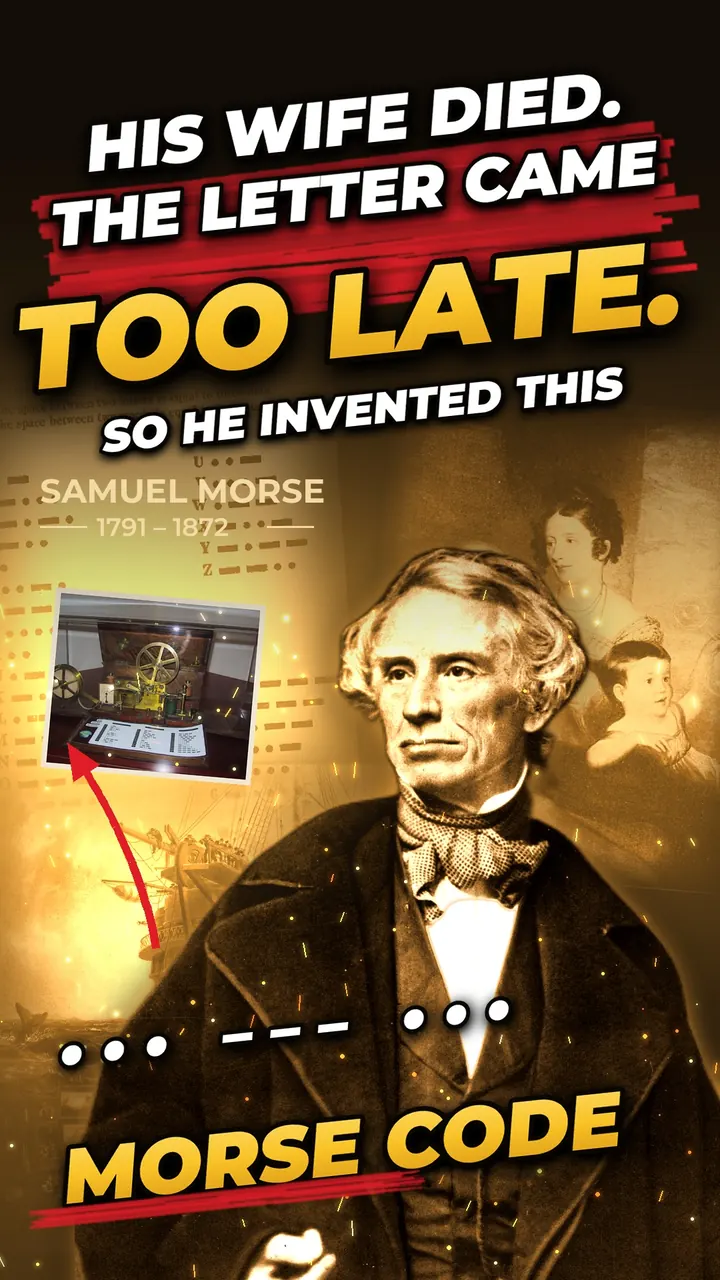
His wife was dying, and he had no idea. By the time the letter reached him, she was already buried.
Samuel Morse was not an inventor at all. He was a painter. In 1825, while he was in Washington painting the Marquis de Lafayette, his young wife Lucretia died after the birth of their third child. The news reached him too late. Seven years later, on a ship back from Europe, he heard passengers talk about electricity travelling instantly along a wire, and he filled his sketchbook with the idea of the telegraph.
He gave up painting, worked for years in poverty, and with his partner Alfred Vail developed a code of dots and dashes. Congress laughed at first, but in 1843 it paid $30,000 for a line from Washington to Baltimore. On 24 May 1844 he tapped out the first message: "What hath God wrought." Within twenty years, wires crossed the continent and a cable crossed the ocean floor. Morse code was still used on ships for more than a century; the Titanic's last calls for help were sent in it.
He was no simple hero: he also defended slavery and campaigned against immigrants. The video says so.
The facts behind this file
What the record shows
- His wife Lucretia died on 7 February 1825 in New Haven. Morse was in Washington painting Lafayette and arrived after the funeral.
- The idea for the telegraph came in 1832, on the packet ship Sully, during a conversation about electromagnetism with Charles Jackson.
- Congress approved $30,000 in March 1843. The first public message went from the Capitol to Baltimore, about 40 miles, on 24 May 1844.
- In 1912 the Titanic's distress calls (CQD and SOS) were sent by wireless in Morse code.
Legends, disputes & careful wording
- His partner Alfred Vail did much of the work on the code. Historians debate who designed which part, so the episode says 'with his partner'.
Spotted a mistake or know a better source? Tell us.
Further reading
As an Amazon Associate, Inventor Files earns from qualifying purchases. It costs you nothing extra.
Image & film credits
- Morse telegraph, 1837: Zubro, CC BY-SA 3.0.
- Other images are public domain or CC0 (Mathew Brady portraits, Morse's own paintings, Library of Congress, The Met); video clips from Pexels. Music and sound made for this video.