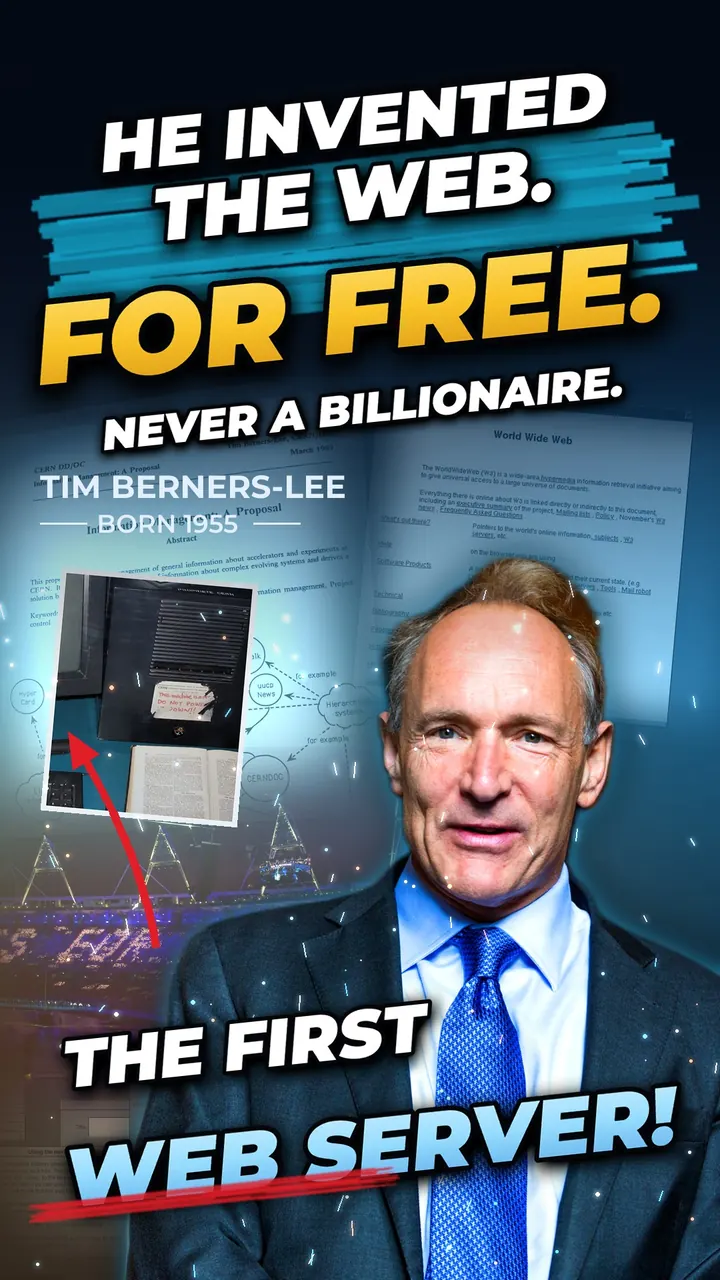
Episode thumbnail: Tim Berners-Lee

Plays from youtube-nocookie.com once you press play.

Short · 2:16 · 2-min read

Tim Berners-Lee He Invented the Web. Then Gave It Away for Free.

You use his invention every single day. And he gave it away for free.

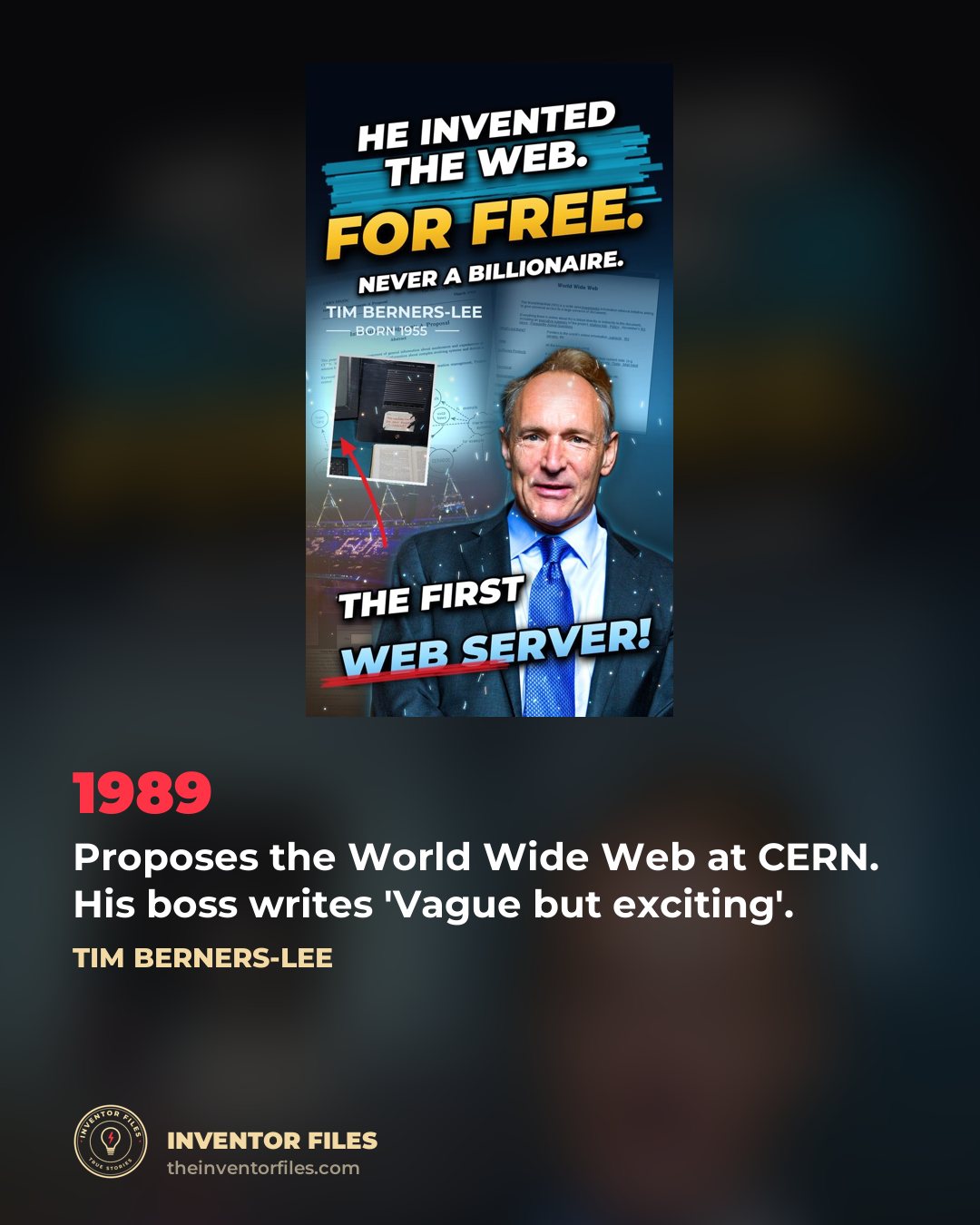
Tim Berners-Lee grew up in London as the son of two mathematicians who worked on one of the first commercial computers. At Oxford he built his own computer from an old television. At CERN, thousands of scientists kept their information on different computers, so in March 1989 he wrote a proposal for a web of linked documents. His boss scribbled on it: "Vague but exciting." On a black NeXT computer he built the first browser, the first web server and the first web page, with a note on the machine: "This machine is a server. DO NOT POWER IT DOWN!!"

He could have patented it. Instead, on 30 April 1993, the web was released free for everyone. In 2012 he typed "This is for everyone" at the London Olympics opening ceremony. Today he warns about fake news, privacy and the power of a few giant companies, and he is still trying to fix the web he gave us.

Read the full story 2 min ↓

The facts behind this file

What the record shows

  • Berners-Lee invented the World Wide Web, not the internet: the network already existed, and the web runs on top of it.
  • His boss Mike Sendall wrote 'Vague but exciting' on the 1989 proposal.
  • On 30 April 1993 CERN put the web software in the public domain.
  • He was knighted in 2004 and received the Turing Award in 2016.

Main sources

  • CERN: the original 1989 proposal and the 1993 public-domain statement

Spotted a mistake or know a better source? Tell us. How we check the facts.

Further reading

As an Amazon Associate, Inventor Files earns from qualifying purchases. It costs you nothing extra.

Image & film credits
  • Tim Berners-Lee 2014: Paul Clarke, CC BY-SA 4.0 · Tim Berners-Lee 2023: Dr. Frank Gaeth, CC BY 4.0 · Tim Berners-Lee 2009: Enrique Dans, CC BY 2.0 · The first web server (NeXT): Coolcaesar, CC BY-SA 3.0 · NeXT server at CERN 2010: Henry Mühlpfordt, CC BY-SA 3.0 · At the 20th anniversary of the web proposal: Maximilien Brice, CERN, CC BY 4.0 · "Information Management: A Proposal": SimonWaldherr, CC BY-SA 4.0 · London 2012 opening ceremony: Nick Webb, CC BY 2.0 · The Queen's College, Oxford: Julian Herzog, CC BY 4.0.
  • Other images are public domain; video clips from Pexels. Music and sound made for this video.
In this story
  1. A family of computer people
  2. Lost information at CERN
  3. "Vague but exciting"
  4. The web is not the internet
  5. Free for everyone
  6. "This is for everyone"
  7. Not entirely happy

The full story · 2 min read

The man who gave away the web: Tim Berners-Lee

In 1989 Tim Berners-Lee proposed a web of linked documents that anyone could reach from any computer. His boss called it "vague but exciting". In 1993 it was made free for everyone. The full story.

A family of computer people

Tim Berners-Lee was born in London in 1955. Both of his parents were mathematicians who worked on one of the first commercially sold computers, the Ferranti Mark 1. At the dinner table they talked about whether computers might one day think like people.

As a student at Oxford he built his own computer, using parts that included an old television set and a soldering iron.

Lost information at CERN

In 1980, and again from 1984, he worked at CERN, the huge particle physics laboratory near Geneva. Thousands of scientists from all over the world worked there, each keeping information in their own way on their own computers. Finding anything was close to impossible.

"Vague but exciting"

In March 1989 Berners-Lee wrote a proposal for a system of documents linked together, which anyone could reach from any computer on the network. His boss, Mike Sendall, wrote three words on the cover: "Vague but exciting". It was enough to let him try.

On a black NeXT computer he built the first web browser, the first web server and the first web page. A label on the machine warned colleagues: "This machine is a server. DO NOT POWER IT DOWN!!" In 1991 the web was opened to people outside CERN.

The web is not the internet

It is worth being precise. Berners-Lee did not invent the internet. The internet, the global network of connected computers, already existed. What he invented was the World Wide Web, a system of pages and links that runs on top of the internet.

Free for everyone

He could have tried to patent his invention and charge for its use. Instead, on 30 April 1993, CERN put the web software in the public domain, free for anyone to use and build on. That decision changed everything. Within a few years there were millions of websites: shops, newspapers, encyclopedias, and later social media. Billions of people came online.

"This is for everyone"

At the opening ceremony of the London 2012 Olympic Games, Berners-Lee appeared at a NeXT computer in the stadium, and the words "This is for everyone" lit up around the arena.

He was knighted in 2004, and in 2016 he received the Turing Award, the highest prize in computer science.

Not entirely happy

Berners-Lee is not entirely happy with what the web has become. He has warned about misinformation, about the loss of privacy, and about a handful of huge companies controlling what people see. He is still working on ways to give people more control over their own data.

The man who gave away the web never became a billionaire. But every link you click still follows the idea he wrote down in 1989.

Sources

  • CERN: the original 1989 proposal and the 30 April 1993 public-domain statement
  • Wikipedia: Tim Berners-Lee; World Wide Web

Researched and written by Inventor Files, last checked 2026-10-31. Found a mistake? Tell us.