Plays from youtube-nocookie.com once you press play.
Felix Hoffmann He Helped Create Aspirin… and Heroin.
“Aspirin and heroin. Sold side by side. By the same company.”
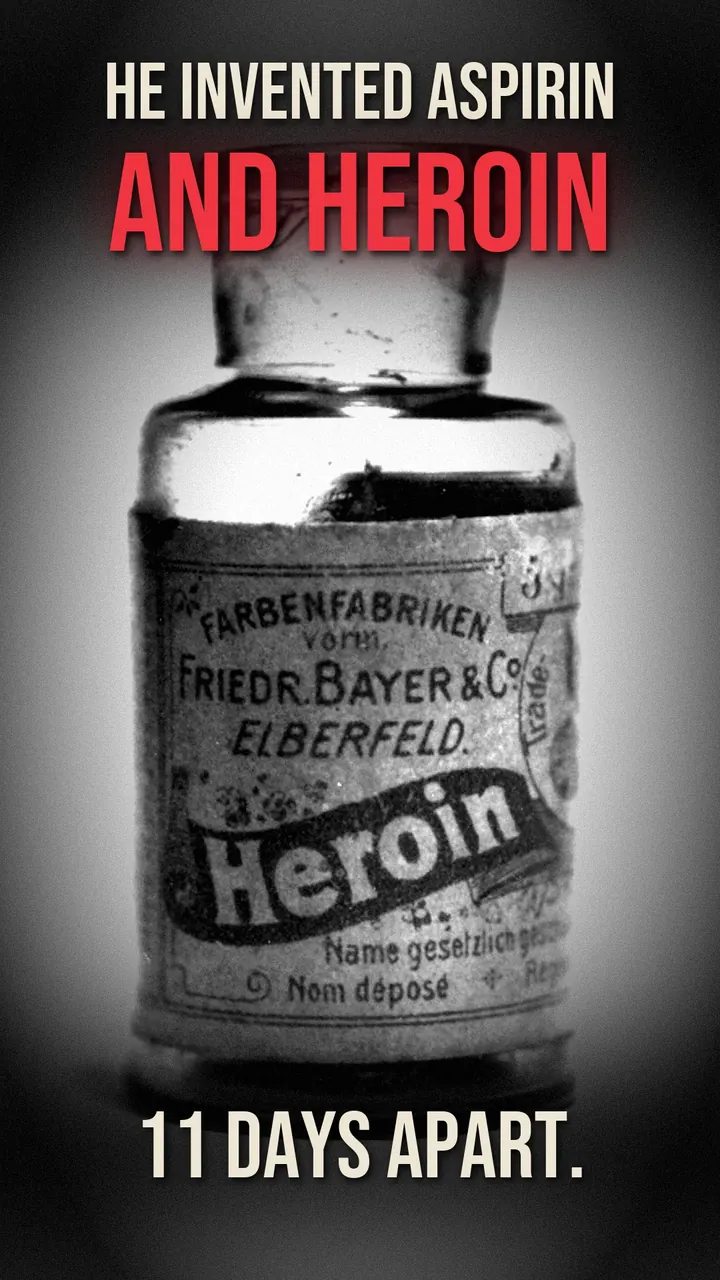
On 10 August 1897, Bayer chemist Felix Hoffmann wrote down a purer way to make acetylsalicylic acid: aspirin. Eleven days later he used the same reaction on morphine and made diacetylmorphine, first made in London in 1874 and then forgotten. Bayer's head of pharmacology, Heinrich Dreser, tested it, found it stronger than morphine, and Bayer sold it from 1898 as "Heroin", a cough medicine it said was not addictive. Aspirin was at first rejected and only launched in 1899. Heroin soon proved highly addictive, and the United States banned it in 1924. Aspirin became one of the most used medicines in the world. Decades later, chemist Arthur Eichengrün said the aspirin idea had been his; historians still argue about who deserves the credit.
The sign in this video is a real American drug-store sign from before the 1924 heroin ban. The lab-book page is Hoffmann's own, dated 10 August 1897.
The facts behind this file
What the record shows
- Felix Hoffmann's lab book records acetylsalicylic acid on 10 August 1897; the page survives in the Bayer archive.
- Eleven days later, on 21 August 1897, he made diacetylmorphine. It had first been made in London in 1874 by C. R. Alder Wright, who did not develop it further.
- Bayer sold it from 1898 under the name Heroin, as a cough medicine, and marketed it as a non-addictive substitute for morphine.
- Bayer registered the Aspirin trademark on 6 March 1899. The US Heroin Act of 1924 banned the manufacture of heroin.
- Heinrich Dreser, head of pharmacology, received royalties on drugs he introduced; Hoffmann, as a chemist, did not.
- Hoffmann retired in 1928 and died in Switzerland on 8 February 1946.
Legends, disputes & careful wording
- That Dreser first rejected aspirin because he feared it would weaken the heart is reported by several historians, but partly rests on Arthur Eichengrün's own 1949 account.
- Who deserves the credit for aspirin is still argued. Eichengrün, who was Jewish, said it was his idea, first in a 1944 letter from Theresienstadt, which he survived, and in a 1949 paper; Walter Sneader (BMJ, 2000) supports him, while Bayer still credits Hoffmann.
- The story that Hoffmann made aspirin for his father's rheumatism first appears in 1934, and is not used in the episode.
- Sources give 1910 or 1913 for when Bayer stopped making heroin.
Main sources
- Science History Institute
- Bayer archive (Hoffmann's lab book, 10 August 1897)
- Walter Sneader, "The discovery of aspirin: a reappraisal", BMJ (2000)
- German Patent and Trade Mark Office (Aspirin trademark, 1899)
Spotted a mistake or know a better source? Tell us.
Image & film credits
- Photos (Wikimedia Commons): Wellcome Collection (CC BY 4.0): Advertisement for Bayer drugs, 1899; portrait of Heinrich Dreser; box of aspirin tablets; liquid morphine shop round; cough-mixture bottle. Bayer AG (CC BY-SA 3.0): early Aspirin bottle. George Chernilevsky (CC BY-SA 4.0): opium poppy. Ragesoss (CC BY-SA 4.0): aspirin tablets. Plan of Theresienstadt, 1942 (CC BY-SA 4.0).
- Public domain: Felix Hoffmann's lab book, 10 August 1897, and portraits of Hoffmann, Arthur Eichengrün and the Bayer laboratories (Bayer archive); Bayer heroin bottle (Mpv_51); "Aspirin & Heroin" drug-store sign (before 1924); Bayer heroin and aspirin adverts (1910s, 1918); Elberfeld postcard (Aug. Finkenrath & Söhne).
- Narration: ElevenLabs (voice "George"). Music made for this video.