Episode thumbnail: Mikhail Kalashnikov

Plays from youtube-nocookie.com once you press play.
The short version · 1:59He Created the AK-47. Then Asked God for Forgiveness.

Documentary · 8:41 · 3-min read

Mikhail Kalashnikov The AK-47’s Inventor Asked God for Forgiveness. This Is the Full Story.

In the last years of his life, Mikhail Kalashnikov wrote to the head of the Russian Orthodox Church. "My spiritual pain is unbearable," he wrote. He asked whether he was responsible for the deaths caused by his rifle.

This is the story of how a boy from a deported peasant family in Siberia, a wounded tank commander with no engineering degree, ended up giving his name to the most widespread rifle on Earth. And the answer to the question people still ask: did he copy it from the Germans?

What we could not verify is said in the video: the hospital conversation is his own account, the letter's exact date is disputed, and some Soviet records are still closed. The 3D scenes are reconstructions with simplified inside parts; the maps are simplified.

Read the full story 3 min ↓

Chapters

  1. 0:00 Cold open: the letter
  2. 0:33 1. A punished family
  3. 1:22 2. War
  4. 2:13 3. First designs
  5. 2:43 4. The short round
  6. 4:09 5. A rifle for the world
  7. 5:22 6. The same answer
  8. 6:12 7. Was it a copy?
  9. 7:52 8. The end

How it works

Take the AK-47 apart, one part at a time, and see what happens when it fires.

A reconstruction, not a scan. Based on "AK-47 Kalashnikov" by Jeyhun1985, CC BY 4.0, simplified for the web. Not every inner part is modelled, so the bolt, recoil spring and cartridges are not shown.

The facts behind this file

What the record shows

  • In 1930 his family was labelled 'kulak' and deported to the Tomsk region in Siberia.
  • As a tank commander he was wounded near Bryansk in the autumn of 1941, during the German drive on Moscow, and spent months in hospital.
  • In 1943 Soviet engineers studied a captured German MKb 42(H) and began work on a shorter cartridge, the 7.62×39. His rifle, reworked with his assistant Aleksandr Zaitsev, was adopted in 1949 and built at Izhevsk.
  • The AK and the StG 44 both use a long-stroke gas piston, but the AK locks with a rotating bolt and the StG 44 with a tilting bolt.
  • In July 2007 he said: "I sleep well. It's the politicians who are to blame." His letter to Patriarch Kirill, asking whether he was guilty for the deaths his rifle caused, was published by Izvestia in January 2014.

Legends, disputes & careful wording

  • The hospital conversation that set him designing rifles is known only from his own recollection.
  • When he wrote the letter is disputed (May 2012 or April 2013), so the film gives no date. His daughter said a priest probably helped him write it.
  • Hugo Schmeisser, designer of the StG 44, worked at Izhevsk from 1946 to 1952. No document shows that the AK was copied, but some Soviet archives are still closed.
  • About 100 million Kalashnikov-type rifles is an estimate.

Main sources

  • Associated Press obituary (December 2013)
  • Izvestia (January 2014), via Al Jazeera and The Moscow Times
  • Tank Archives, 'Schmeisser vs Kalashnikov' (2019)
  • C. J. Chivers, The Gun (2010)
  • Wikipedia: Mikhail Kalashnikov, AK-47, StG 44, Hugo Schmeisser

Spotted a mistake or know a better source? Tell us. How we check the facts.

Image & film credits
  • Image credits (Wikimedia Commons, file name: author, licence)
  • - Mikhail_Kalashnikov_-_C.jpg: ambrett from Sydney, Australia, CC BY 2.0
  • - Patriarch_Kirill_(2).jpg: The Presidential Press and Information Office, CC BY 4.0
  • - Kalashnikov_Mikhail_(1).jpg: Министерство обороны Российской Федерации, CC BY 4.0
  • - Курья,_Церковь_Знамения.jpg: Kidus22, CC BY-SA 4.0
  • - RIAN_archive_79113_Seizing_grain_from_kulaks.jpg: Alpert / Макс Альперт, CC BY-SA 3.0
  • - Lavrinenko_tank_crew.jpg: Unknown authorUnknown author, Public domain
  • - Bundesarchiv_B_145_Bild-F016199-10,_Zerstörter_sowjetischer_Panzer.jpg: Unknown authorUnknown author, CC BY-SA 3.0 de
  • - Медсанбат.jpg: Mikhail Mikhaylovich Kalashnikov, Public domain
  • - Bundesarchiv_Bild_101I-278-0899-26,_Russland,_Soldat_mit_MP_40_im_Schnee.jpg: Bundesarchiv, Bild 101I-278-0899-26 / Wehmeyer, CC BY-SA 3.0 de
  • - Пистолет_Пулемет_Калашникова_1942_года.jpg: Arseniy32, CC BY 4.0
  • - Kalashnikov_Mikhail_(5).jpg: Министерство обороны Российской Федерации (mil.ru), CC BY 4.0
  • - MKb_42_(H,_),_AM.045900,_01.jpg: Swedish Army Museum, CC BY 4.0
  • - Kovrov._Heritage_Fifth_House.jpg: Алексей Белобородов, CC BY-SA 3.0
  • - Kalashnikov_Museum-11.jpg: Vyacheslav Bukharov, CC BY-SA 4.0
  • - AK-47_type_II_Part_DM-ST-89-01131.jpg: US Department of Defense, Public domain
  • - Aerial_photographs_of_Izhevsk-108.jpg: Vyacheslav Bukharov, CC BY-SA 4.0
  • - Izhmash_museum-12.jpg: Vyacheslav Bukharov, CC BY-SA 4.0
  • - AKM_automatkarbin,_Ryssland_-_7,62x39mm_-_Armémuseum.jpg: Armémuseum (The Swedish Army Museum), CC BY 4.0
  • - Viet_Cong_weapons_captured_in_Cholon.jpg: SP5 J. F. Fitzpatrick, Jr., Public domain
  • - Flag_of_Mozambique.svg: FRELIMO, Public domain
  • - Medvedev_awarding_Mikhail_Kalashnikov_01.jpg: kremlin.ru, CC BY 4.0
  • - Moscow_July_2011-34a.jpg: Alvesgaspar, CC BY-SA 3.0
  • - Bundesarchiv_Bild_146-1979-118-55,_Infanterist_mit_Sturmgewehr_44.jpg: Bundesarchiv, Bild 146-1979-118-55 / unknown photographer, CC BY-SA 3.0 de
  • - Pistol,_Rifle_and_Intermediate_cartridge.jpg: Sumek101, CC BY-SA 4.0
  • - MP44_-_Tyskland_-_8x33mm_Kurz_-_Armémuseum.jpg: Armémuseum (The Swedish Army Museum), Public domain
  • - Infantryman_in_1942_with_M1_Garand,_Fort_Knox,_KY.jpg: Alfred T. Palmer (US Office of War Information), Public domain
  • - Federal_Military_Memorial_Cemetery_Catafalque.jpg: AntipovSergej, CC BY-SA 4.0
  • - Sturmgewehr44_noBG(1).jpg: Armémuseum (The Swedish Army Museum), CC BY-SA 4.0
  • - 3D models: "AK-47 Kalashnikov" by Jeyhun1985 and "STG - 44 | Sturmgewehr" by ELIZION (Sketchfab, CC BY 4.0), cut away and animated by us
  • - Maps: 3D relief from NASA Earth Observatory (Blue Marble topography, imagery by Jesse Allen, using GEBCO data from the British Oceanographic Data Centre); borders from Natural Earth (public domain). Cartridge drawing: our own, to published dimensions.
  • Changes: photos cropped, placed on a blurred backdrop and labelled; museum photos with the background removed where noted. Licences: CC BY 2.0 / 3.0 / 4.0 and CC BY-SA 3.0 / 3.0 de / 4.0, see each file page on Wikimedia Commons.
  • Music: "Lightless Dawn" and "Interloper" by Kevin MacLeod (incompetech.com), licensed under Creative Commons: By Attribution 4.0 (creativecommons.org/licenses/by/4.0/).
In this story
  1. A punished family
  2. War
  3. First designs
  4. The short round
  5. A rifle for the world
  6. Was it a copy?
  7. The same answer, then a different question
  8. What we could not verify

The full story · 3 min read

Did Kalashnikov copy the AK-47? The full story

A deported peasant boy and wounded tank commander gave his name to the most widespread rifle on Earth. Did he copy it from the Germans? What the records show, and what they don't.

A punished family

Soviet officials seizing grain from peasants

1930 · the family is deported

Grain being seized from peasants labelled 'kulaks' in the Soviet Union. Photo: Max Alpert (RIA Novosti archive).

Mikhail Kalashnikov was born in 1919 in Kurya, a village in the Altai region of Siberia. By his own account he was the seventeenth of nineteen children, and only eight of them reached adulthood.

In 1930 the Soviet state labelled his family "kulaks", peasants it treated as class enemies. Their property was taken and they were deported to the Tomsk region, deeper into Siberia. Before the army he worked as a railway clerk.

War

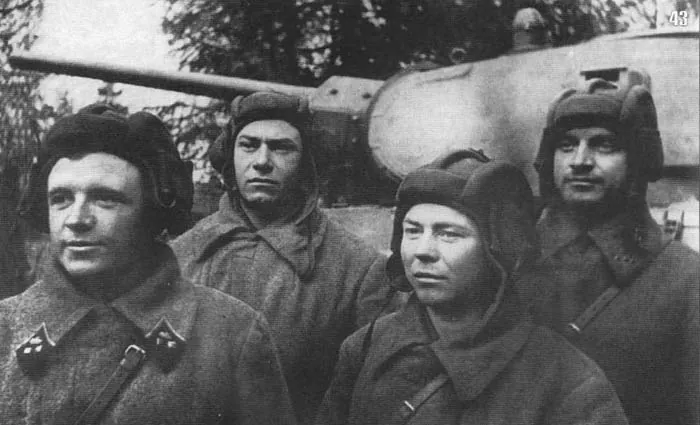
A Soviet tank crew posing beside their tank

Autumn 1941 · Bryansk

A Soviet tank crew in 1941 (the crew of Dmitry Lavrinenko, not Kalashnikov's own).

He was called up in 1938 and trained as a tank mechanic, then became a tank commander. He was good with machines and made small improvements to his tanks.

In the autumn of 1941 the German army drove towards Moscow. Near Bryansk a shell hit his tank and he was badly wounded. He spent months in hospital. Later he said that a soldier there asked him why the Germans had automatic weapons while Soviet soldiers had to share rifles. We only have his word for that conversation, but it is how he always explained what came next.

First designs

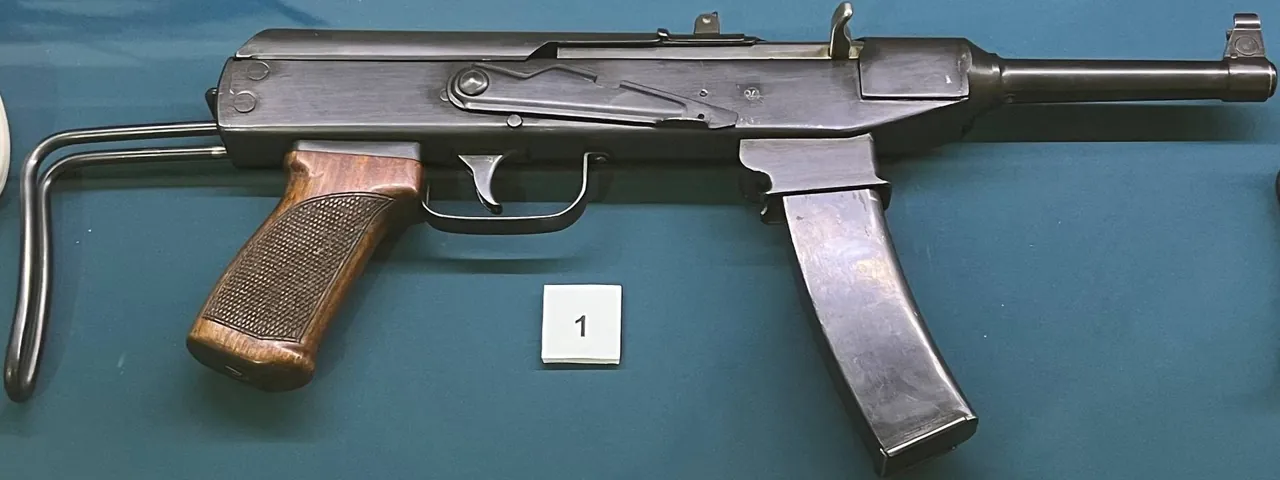
Kalashnikov's 1942 submachine gun in a museum
Kalashnikov's first submachine gun, 1942. It was not adopted, but his talent was noticed.

In hospital and afterwards he began to draw weapons. His first submachine gun, in 1942, was not adopted, but people noticed his talent and moved him into weapons design. In 1944 his carbine lost a competition to Sergei Simonov's design, which became the SKS.

The short round

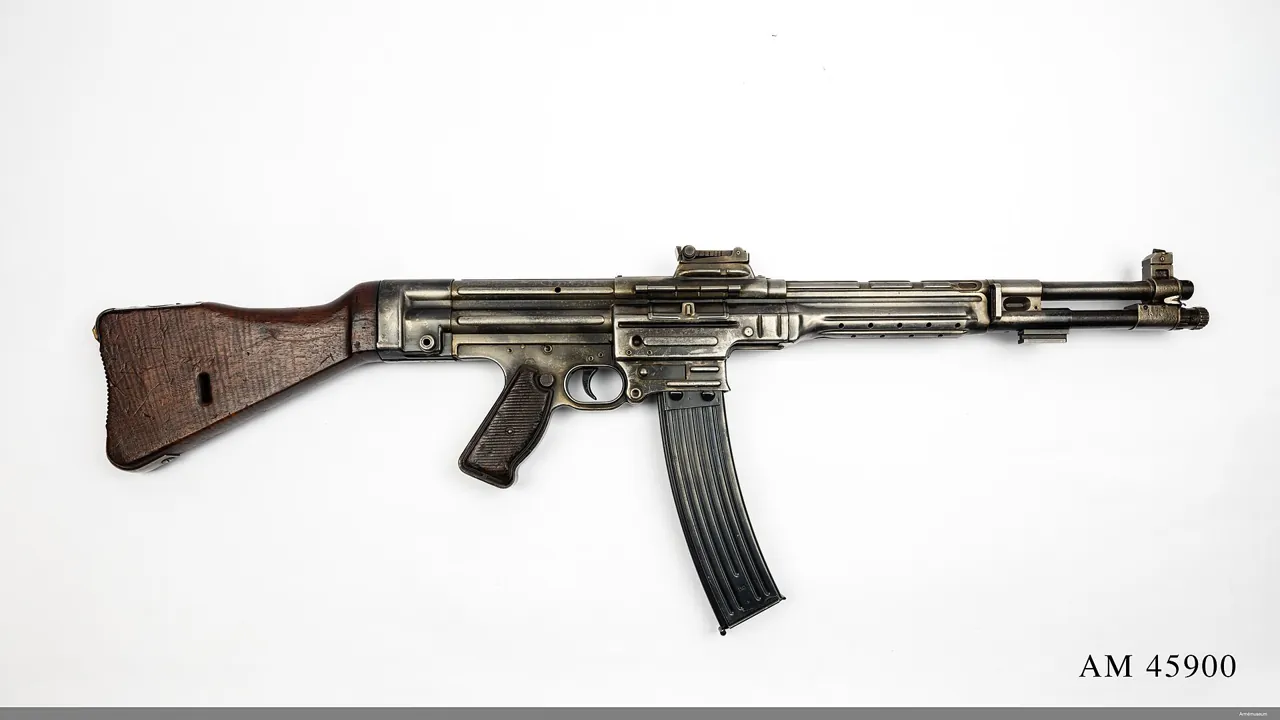
A German MKb 42(H) rifle on a museum background

7.62×39 · the short round

A German MKb 42(H), the type of rifle Soviet engineers studied in 1943. Swedish Army Museum.

The key idea did not start with him. In 1943 Soviet engineers studied a German rifle captured at the front, the MKb 42(H). It fired a cartridge between a pistol round and a full rifle round: short enough to control in automatic fire, strong enough for real distances. That summer the Soviets began work on their own short cartridge, the 7.62×39. It was adopted after trials at the end of 1943.

A new cartridge needed a new rifle. In 1946 a competition was held. Kalashnikov's entry had a rotating bolt. Late in 1946 his assistant, Aleksandr Zaitsev, proposed a major redesign, and in November 1947 the prototype appeared with a long gas piston above the barrel. The rifle was adopted in 1949 and built at Izhevsk, where Kalashnikov lived for the rest of his life.

A rifle for the world

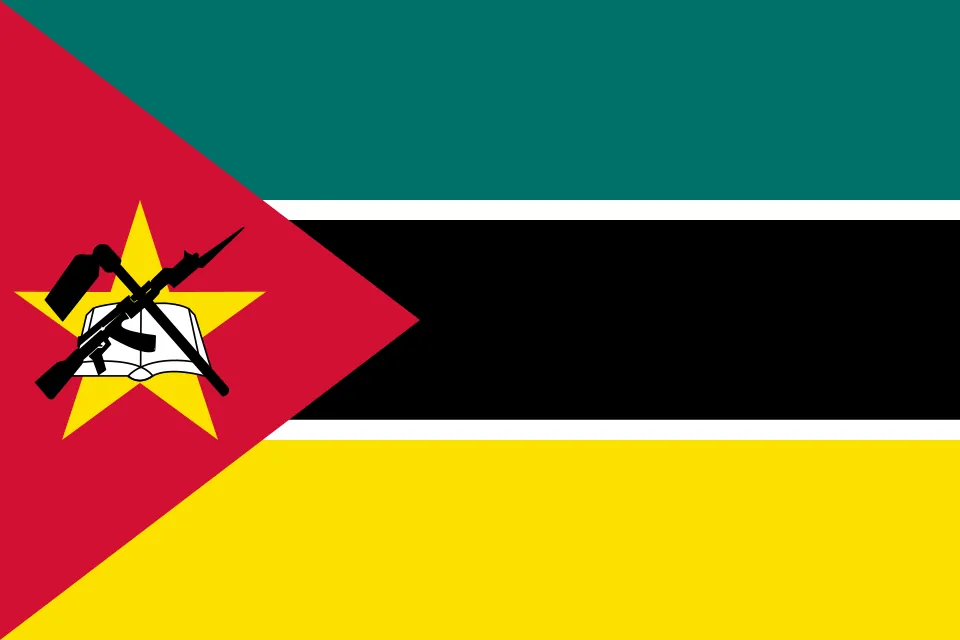
The flag of Mozambique, with a rifle in its emblem

About 100 million rifles

The flag of Mozambique, adopted in 1983, with an AK-47 in its emblem.

The AK was simple, cheap to make and kept working in mud, sand and snow. The Soviet Union gave it to its allies and helped them build their own factories. It was used by North Vietnamese and Viet Cong forces against American troops, and it is on the flag of Mozambique. About 100 million Kalashnikov-type rifles have been made, by one widely quoted estimate.

Kalashnikov became a lieutenant general and received the highest Soviet honours. He did not get rich from royalties.

Was it a copy?

A German StG 44 assault rifle on a white background
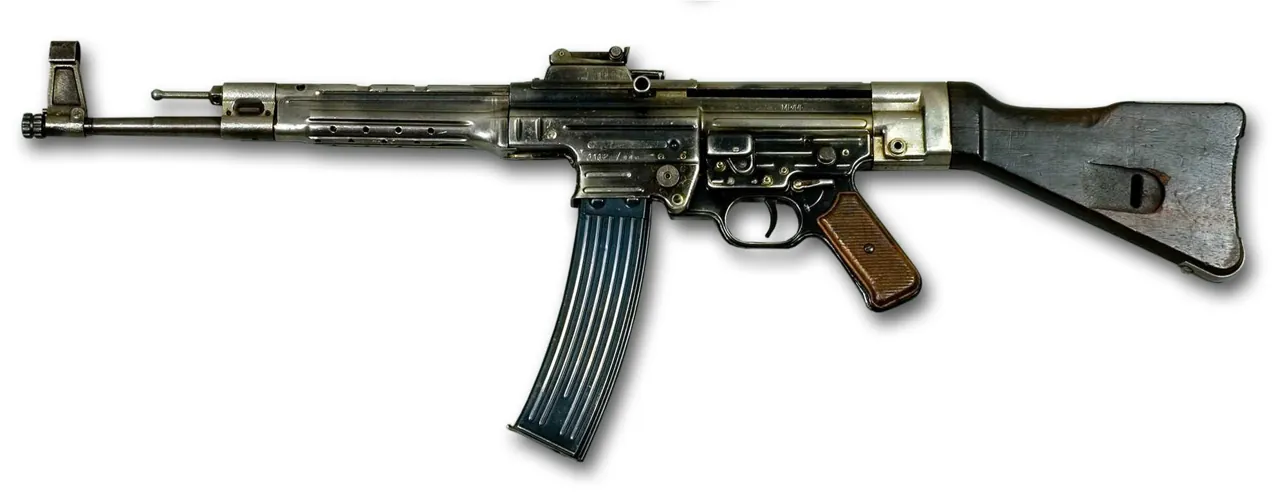
A German StG 44 (Swedish Army Museum). From the outside it looks like the AK; inside, its bolt tilts instead of rotating.

The question comes up because of the German StG 44, the assault rifle that followed the MKb 42(H). From the outside the two rifles look alike, and its designer, Hugo Schmeisser, was brought to Izhevsk after the war and worked there from 1946 to 1952.

Inside they are different machines. Both use gas from the barrel to drive a long piston. But the StG 44 locks by tilting its bolt, and the AK locks by rotating it. The AK took its basic layout before Schmeisser could have shaped it, and Soviet archive documents show that German specialists were kept away from secret projects. No document shows that the AK was copied. Some Soviet records are still closed, so the question cannot be closed completely.

Historians such as C. J. Chivers also point out that the AK came out of a whole Soviet system of engineers, trials and factories, not from one man alone. Kalashnikov's own accounts of how it began changed over the years.

The same answer, then a different question

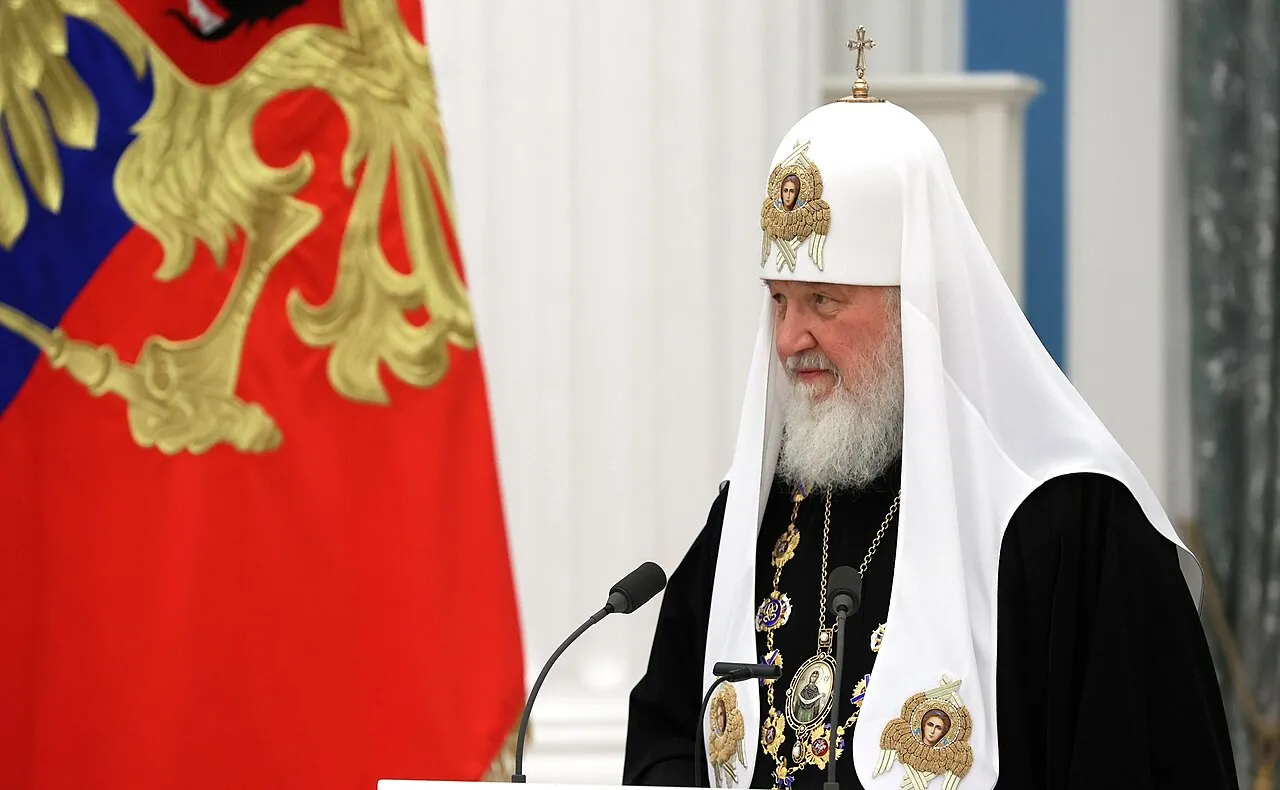
Patriarch Kirill of Moscow
Patriarch Kirill, head of the Russian Orthodox Church, to whom Kalashnikov wrote his letter. Photo from 2021.

For most of his life he gave the same answer. In July 2007 he said: "I sleep well. It's the politicians who are to blame." But near the end of his life he wrote to Patriarch Kirill, the head of the Russian Orthodox Church. "My spiritual pain is unbearable," he wrote, and asked whether he was responsible for the deaths his rifle had caused. Izvestia published the letter in January 2014. When he wrote it is disputed, and his daughter said a priest probably helped him.

He died in Izhevsk in December 2013, aged 94.

What we could not verify

The hospital conversation is his own account. The date of the letter is disputed. The 3D scenes in the documentary are reconstructions, and some inner parts are simplified. And a sentence often quoted on the internet, that he combined "the best features" of the American M1 Garand and the StG 44, could not be traced to a reliable source, so we do not use it.

Sources

  • Associated Press obituary, December 2013
  • Izvestia, January 2014, via Al Jazeera and The Moscow Times
  • Tank Archives, "Schmeisser vs Kalashnikov" (2019)
  • Forgotten Weapons, on the captured MKb 42(H) and the first AK
  • C. J. Chivers, The Gun (2010)
  • Wikipedia: Mikhail Kalashnikov; AK-47; StG 44; Hugo Schmeisser; 7.62×39mm
Photo credits

Researched and written by Inventor Files, last checked 2026-11-05. Found a mistake? Tell us.