
Plays from youtube-nocookie.com once you press play.
Auguste Piccard Trapped in the Sky, 16 km Up
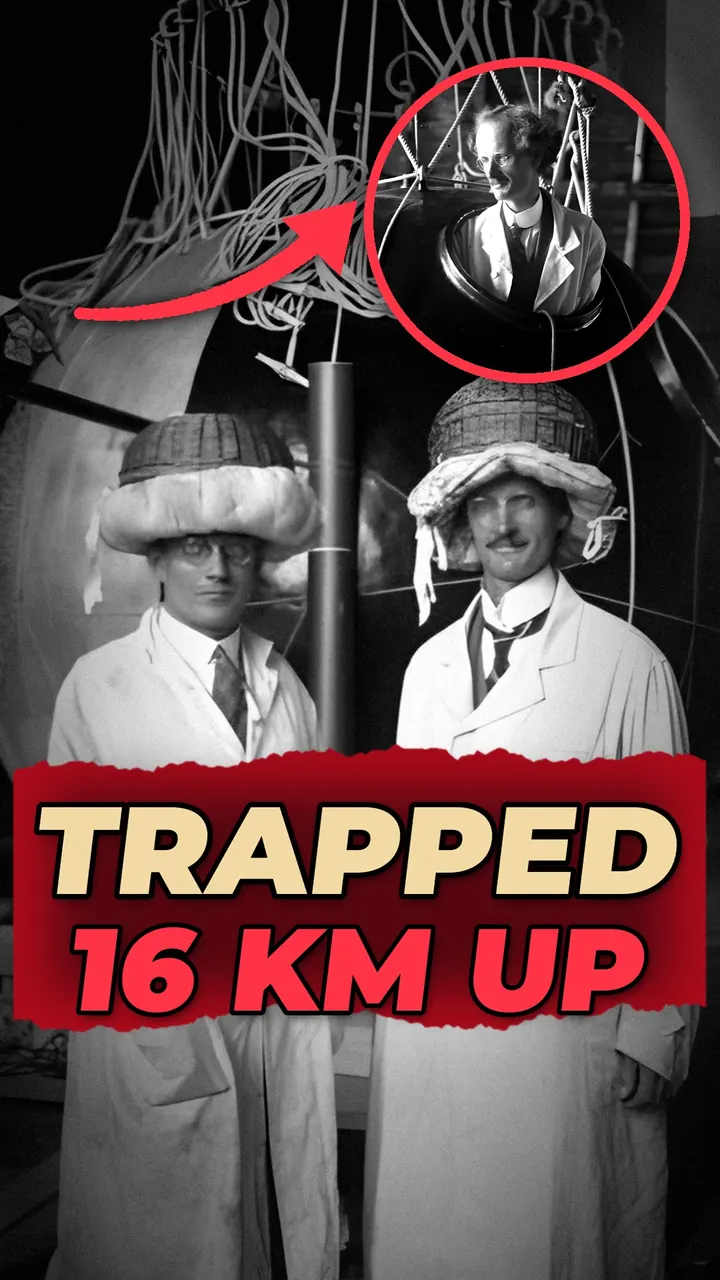
On 27 May 1931 the Swiss physicist Auguste Piccard and his assistant Paul Kipfer took off from Augsburg, Germany, in a sealed aluminium ball 2.10 metres wide, hanging under a hydrogen balloon. It was a pressurised cabin with its own oxygen, built so they could reach the stratosphere without pressure suits. The ground crew let go before the agreed signal. Early in the climb air began to escape through a damaged seal, and Piccard plugged it with Vaseline and cloth. They reached about 15,780 metres, higher than any human had been. Then the gas valve would not work, so they could not come down. The motor that was meant to turn the half-black, half-white ball stopped, and the cabin heated up. According to later accounts they ran out of drinking water and licked condensation off the walls. Only when the sun went down did the gas cool and the balloon sink. Around nine in the evening they landed on the Gurgl glacier in the Austrian Alps, spent the night on the ice and were met by a rescue party the next day. Auguste later designed the bathyscaphe Trieste, which his son Jacques took to the bottom of the Mariana Trench in 1960. His grandson Bertrand flew the first nonstop balloon flight around the world in 1999.
The landing scene is the cover illustration of Le Petit Journal illustré, 7 June 1931.
The facts behind this file
What the record shows
- On 27 May 1931 the Swiss physicist Auguste Piccard and his assistant Paul Kipfer took off from Augsburg, Germany, in a sealed aluminium ball 2.10 metres wide under a hydrogen balloon. It was a pressurised cabin with its own oxygen.
- They reached about 15,780 metres, higher than anyone had been before: the first people in the stratosphere.
- Early in the climb air leaked through a damaged seal, and Piccard plugged it with Vaseline and cloth. Then the gas valve would not work, so they could not come down until the sun set and the gas cooled.
- After about 17 hours in the air they landed on the Gurgl glacier in the Austrian Alps, spent the night on the ice and were met by a rescue party the next day.
- Piccard later designed the bathyscaphe Trieste, which his son Jacques took to the bottom of the Mariana Trench in 1960. His grandson Bertrand flew Breitling Orbiter 3 nonstop around the world in 1999.
Legends, disputes & careful wording
- The landing date: a Piccard family fact sheet gives 28 May, but UPI and later accounts place the landing on the evening of 27 May, followed by the night on the ice.
- Why the valve failed: some sources say it froze shut, others that its rope was fouled. The episode only says it would not open.
- The early release before the agreed signal and the cause of the leak come from one source (EBSCO); that the crew ran out of water and licked condensation off the walls comes from later accounts.
Main sources
- Bertrand Piccard, fact sheet FNRS 1
- FAI record file 10634
- UPI report, dateline Gurgl, 28 May 1931
- EBSCO Research Starters: Piccard Travels to the Stratosphere by Balloon
- Science History Institute: Death-Defying Science at 75,000 Feet
- Popular Science, August 1931
- ExplorersWeb
Spotted a mistake or know a better source? Tell us. How we check the facts.
Image & film credits
- Photos (Wikimedia Commons): Bundesarchiv, Bild 102-10379, 102-10380, 102-10382, 102-10404, 102-11505, 102-11753, 102-11754, 102-11764, 102-11765, 102-11766, 102-11767, 102-11768 (photographers unknown, CC BY-SA 3.0 DE; archive caption strips cropped). Ad Meskens: the 1931 gondola, Royal Museum of the Armed Forces, Brussels (CC BY-SA 4.0). Anton-kurt: Piccard monument, Obergurgl (CC BY-SA 3.0). User-duck: Breitling Orbiter 3 aloft (CC BY-SA 3.0). John Mathew Smith & celebrity-photos.com: Bertrand Piccard and Brian Jones (CC BY-SA 2.0). Public domain: Le Petit Journal illustré, 7 June 1931; Walter Mittelholzer, Gurgler Ferner, 1933 (ETH-Bibliothek Zürich); Auguste Piccard at the 1927 Solvay Conference; US Navy photos of the bathyscaphe Trieste (1958–1960); NASA (ISS Expedition 23 sunset; ISS Expedition 74 photo of the Moon above Earth's atmosphere).
- Small photos were enlarged with Real-ESRGAN.
- Music made for this video.