
Plays from youtube-nocookie.com once you press play.
Hiram Maxim He Invented the Machine Gun. Then Made Something Nobody Expected.
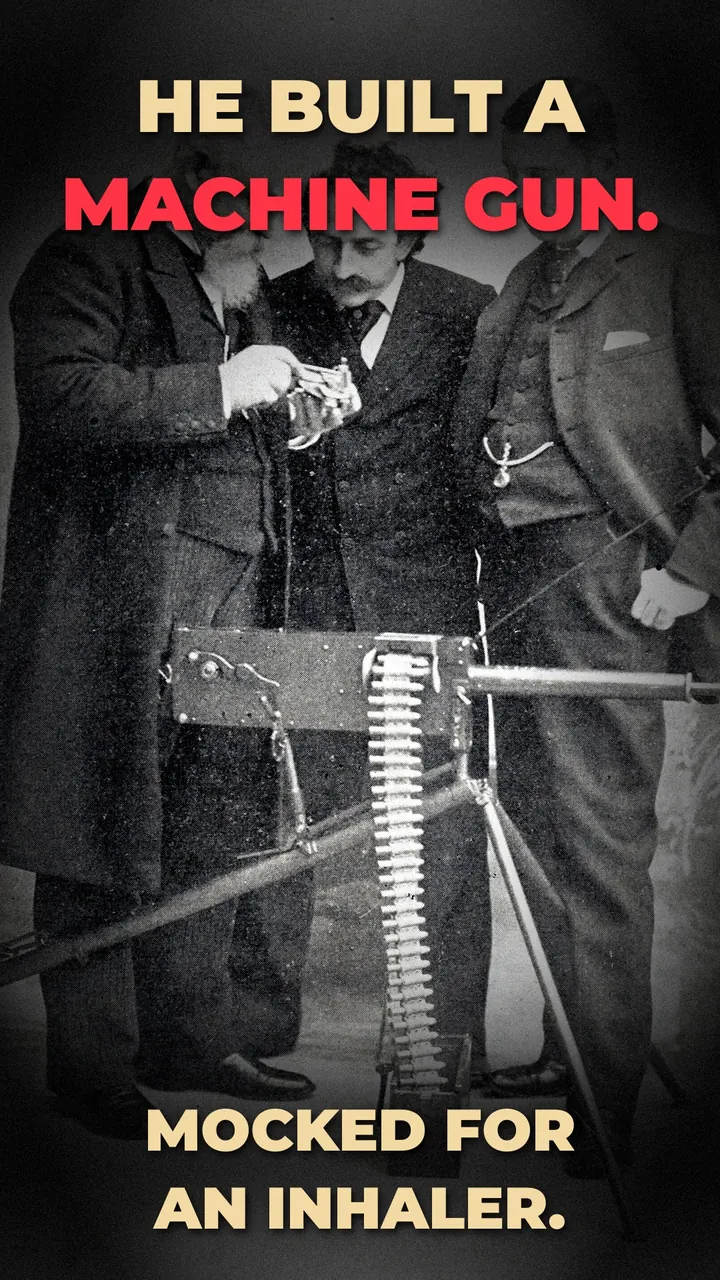
Hiram Stevens Maxim was born in Sangerville, Maine, in 1840. He left school young to work for a carriage maker and went on to invent a mousetrap, curling irons, gas machines and electric lighting, competing with Edison. After the Paris electrical exhibition of 1881 he turned to a new idea: a gun that would use its own recoil to eject the empty case, load the next round and fire again for as long as the trigger was held. He built it in a workshop at Hatton Garden, London, in 1884. In his memoir he says it fired 666 rounds in one minute. Royalty and generals came to fire it, and armies across Europe bought it. In colonial wars in Africa small forces with a few Maxims defeated much larger armies, which Hilaire Belloc summed up in 1898: "Whatever happens, we have got / The Maxim gun, and they have not." Maxim became a British subject in 1900 and was knighted in 1901. Suffering from bronchitis, he also made and sold an inhaler, and critics said he had disgraced himself by stooping to "quack nostrums". In his memoir My Life (1915, p. 315) he answered: "From the foregoing it will be seen that it is a very creditable thing to invent a killing machine, and nothing less than a disgrace to invent an apparatus to prevent human suffering." In 1916, machine guns built on his design (the German MG 08 and the British Vickers) faced each other on the Somme; on the first day alone, 1 July 1916, about 19,240 British soldiers were killed. Maxim died in London that November.
The "cut each other's throats" advice is the story as Maxim's biographers tell it; we did not find it in My Life itself. No images of the dead are shown. Film: "German War Film, 1914-1918" (US Signal Corps Historical Film No. 1102) and "The Battle of the Somme" (1916), both public domain.
Image & film credits
- Photos and drawings (Wikimedia Commons unless noted): Spudgun67 (CC BY-SA 4.0): blue plaque, 57d Hatton Garden. Auckland War Memorial Museum (CC BY 4.0): Maxim machine gun (AM 775501). Wellcome Collection (CC BY 4.0): Sir Hiram Maxim's "Pipe of Peace" (L0035433, L0035435) and its instructions leaflet (L0006992). Alf van Beem (CC0): MG 08, Musée Somme 1916. Smithsonian Institution (no known restrictions): portrait of Hiram Stevens Maxim. Public domain: Cassier's Magazine, April 1895 (Maxim with a machine gun; his flying machine); Smithsonian Institution Libraries portrait, 1912; Leslie Ward, Vanity Fair, 1904; young Maxim, about 1857; Die Gartenlaube, 1881; Palais de l'Industrie, Paris; Encyclopaedia Britannica 1911, Maxim gun mechanism; Maggie Jones, Hatton Garden; Imperial War Museums Q81725, Q71995; Edward VII firing a Maxim gun; Navy and Army Illustrated, 1890s; Hiram S. Maxim, My Life (McBride, Nast & Co., 1915), pages 313 and 315 (Internet Archive).
- Film (public domain, via Wikimedia Commons): US Army Signal Corps, "German War Film, 1914-1918" (Historical Film No. 1102): an MG 08 crew, troops at the Brandenburg Gate in 1914, a barrage at the Somme in 1916. Geoffrey Malins and John McDowell, "The Battle of the Somme" (1916): the Lancashire Fusiliers in the sunken road, 1 July 1916.
- Narration: ElevenLabs (voice "George"). Music made for this video.