Episode thumbnail: Alfred Nobel

Plays from youtube-nocookie.com once you press play.

Short · 2:53 · 2-min read

Alfred Nobel Some Called Him the Merchant of Death

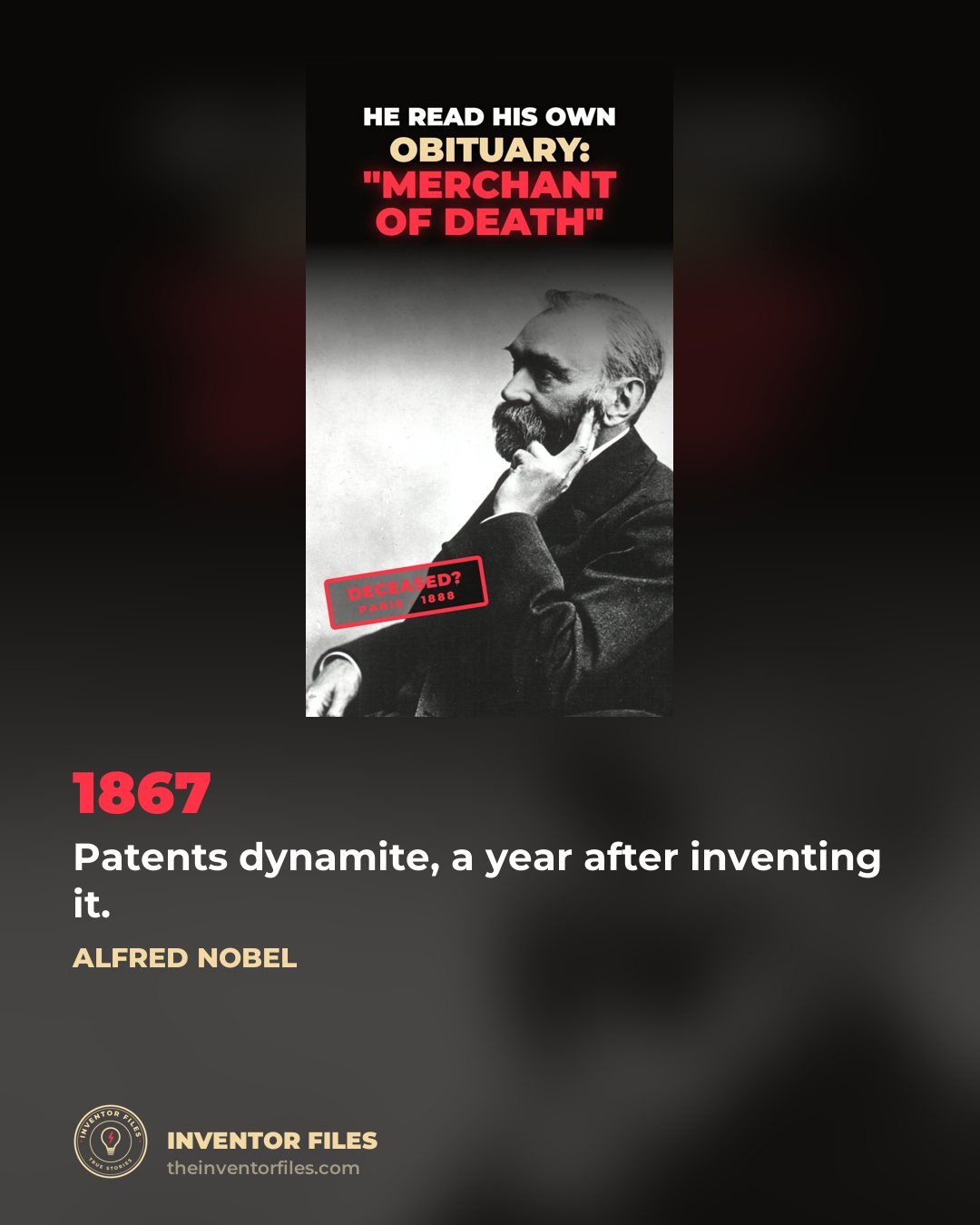
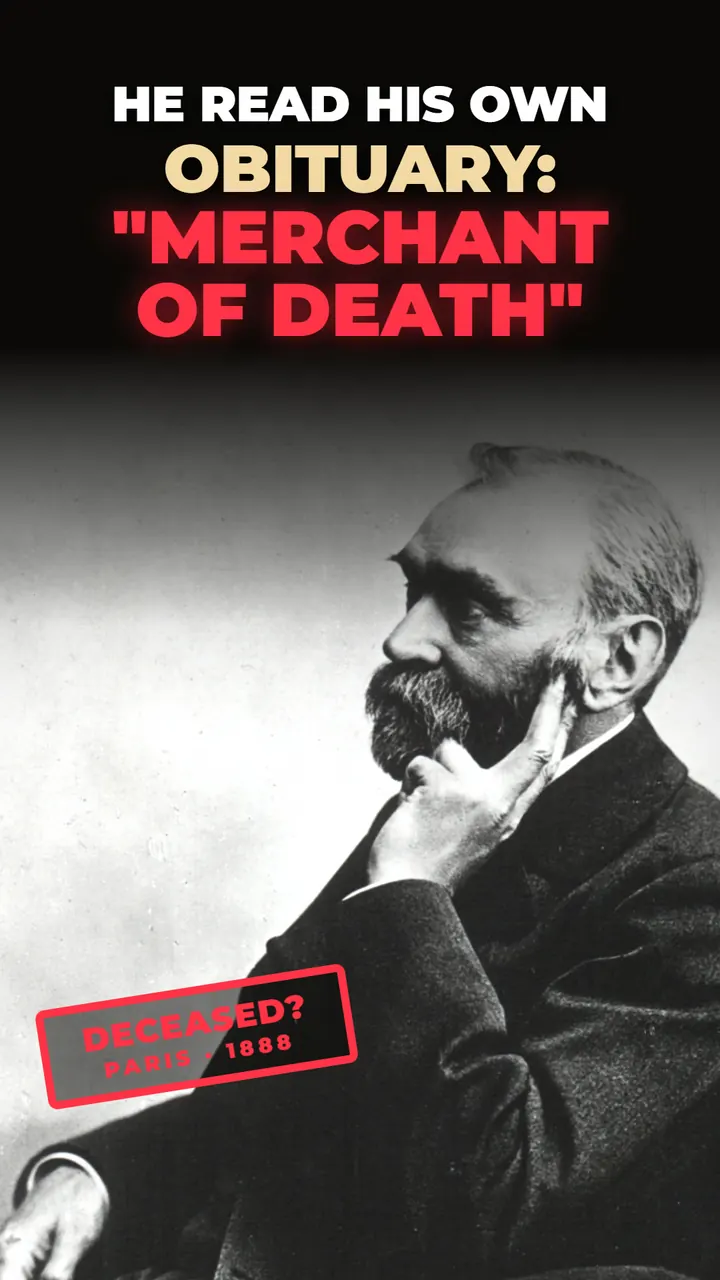
In 1888, Alfred Nobel opened a French newspaper and, as the story goes, read his own obituary: "The merchant of death is dead." He wasn't dead. His brother Ludvig was.

Nobel grew up between bankruptcy and riches, learned chemistry and five languages from private tutors, and set out to tame nitroglycerin. In 1864 an explosion at the family workshop in Stockholm killed five people, including his younger brother Emil. Three years later he invented dynamite, which blasted tunnels through the Alps and made him one of the richest men in Europe, and was also used in war.

In 1895 he signed his last will in Paris: almost his entire fortune would fund prizes for those who brought the greatest benefit to mankind. The first Nobel Prizes were awarded in 1901. His friend Bertha von Suttner won the peace prize in 1905.

Read the full story 2 min ↓

The facts behind this file

What the record shows

  • Nobel spoke six languages.
  • On 3 September 1864 an explosion at the family's Heleneborg works in Stockholm killed five people, including his younger brother Emil.
  • He invented dynamite in 1866 and patented it in 1867.
  • On 27 November 1895, at the Swedish-Norwegian Club in Paris, he signed a will leaving about 94% of his fortune to the prizes. They have been awarded since 1901.
  • His friend Bertha von Suttner won the Peace Prize in 1905.

Legends, disputes & careful wording

  • The famous obituary headline 'The merchant of death is dead', supposedly printed by mistake when his brother died, has never been found. That is why the episode tells it as a story.

Main sources

  • Encyclopaedia Britannica: Alfred Nobel
  • Kenne Fant, Alfred Nobel: A Biography
  • Smithsonian Magazine (2013), on the obituary story

Spotted a mistake or know a better source? Tell us. How we check the facts.

Image & film credits
  • Alfred Nobel's will, 1895 (pages 1 and 4): Waage, CC BY-SA 3.0.
  • Other archival photos are public domain (incl. Library of Congress, Swedish archives); video clips from Pexels.
  • Music and sound made for this video.
In this story
  1. A bankrupt father and a rich childhood
  2. The explosion at Heleneborg
  3. Dynamite
  4. A lonely man and a friend for peace
  5. The obituary
  6. The will

The full story · 2 min read

Alfred Nobel: from dynamite to the most famous prize on Earth

Alfred Nobel invented dynamite, built factories across the world and became one of the richest men in Europe. Then he left almost his entire fortune to the Nobel Prizes. The full story, and the famous obituary that may be a myth.

Sticks of dynamite: nitroglycerine soaked into a porous earth and wrapped in paper, as Nobel patented in 1867. A model. Drag to turn it.

A bankrupt father and a rich childhood

Alfred Nobel was born in Stockholm in 1833, the year his father, the engineer Immanuel Nobel, went bankrupt. The family later followed the father to Saint Petersburg, where he built naval mines for the Russian army and navy and grew rich.

Alfred never went to university. Private tutors taught him chemistry, literature and languages; he became fluent in six. In Paris he met the Italian chemist Ascanio Sobrero, who had discovered nitroglycerin, an explosive far more powerful than gunpowder. Its problem was that it was unstable: a small shock could set it off. Nobel was convinced he could tame it.

The explosion at Heleneborg

On 3 September 1864 an explosion at the family's works at Heleneborg in Stockholm killed five people. One of them was his younger brother Emil, who was twenty. Stockholm banned the experiments within the city, and for a time Nobel continued his work on a barge on a lake outside town.

Dynamite

In 1866 he found the answer: he mixed nitroglycerin into a fine, absorbent earth called kieselguhr and shaped the paste into sticks. It was powerful but safe enough to transport and handle. He called it dynamite and patented it in 1867.

Dynamite changed the world. It blasted tunnels through mountains and cleared the way for canals, railways, roads and mines. Nobel built factories in more than twenty countries and registered 355 patents. He became one of the richest men in Europe. But dynamite was also used in war, and he later developed a smokeless military gunpowder.

A lonely man and a friend for peace

Nobel never married, lived alone for much of his life and called himself a misanthrope. One of his closest friends was the Austrian writer Bertha von Suttner, who became one of the leaders of the European peace movement. He reportedly told her that his factories might put an end to war sooner than her congresses.

The obituary

In April 1888 Alfred's brother Ludvig died. According to a famous story, a French newspaper confused the brothers and printed an obituary of Alfred instead, under the headline "The merchant of death is dead", and seeing it made Alfred think about how he would be remembered.

It is a powerful story, but the obituary itself has never been found, and Nobel never wrote about it. That is why our episode tells it as a story, not as a fact.

The will

On 27 November 1895, at the Swedish-Norwegian Club in Paris, Nobel signed his last will. About 94 per cent of his fortune was to go to a fund, whose interest would be awarded every year as prizes to those who had brought the greatest benefit to mankind: in physics, chemistry, physiology or medicine, literature and peace.

Nobel died in San Remo, Italy, on 10 December 1896, at the age of 63. His relatives contested the will, and it took several years of legal battles before the first Nobel Prizes were awarded, in 1901.

In 1905 his old friend Bertha von Suttner received the Nobel Peace Prize. Today the Nobel Prize is the most famous award in the world, and the man who made his money from explosives is remembered for it.

Sources

  • Encyclopaedia Britannica: Alfred Nobel
  • Kenne Fant, Alfred Nobel: A Biography
  • Smithsonian Magazine (2013), on the obituary story
  • The Nobel Foundation

Researched and written by Inventor Files, last checked 2026-10-31. Found a mistake? Tell us.